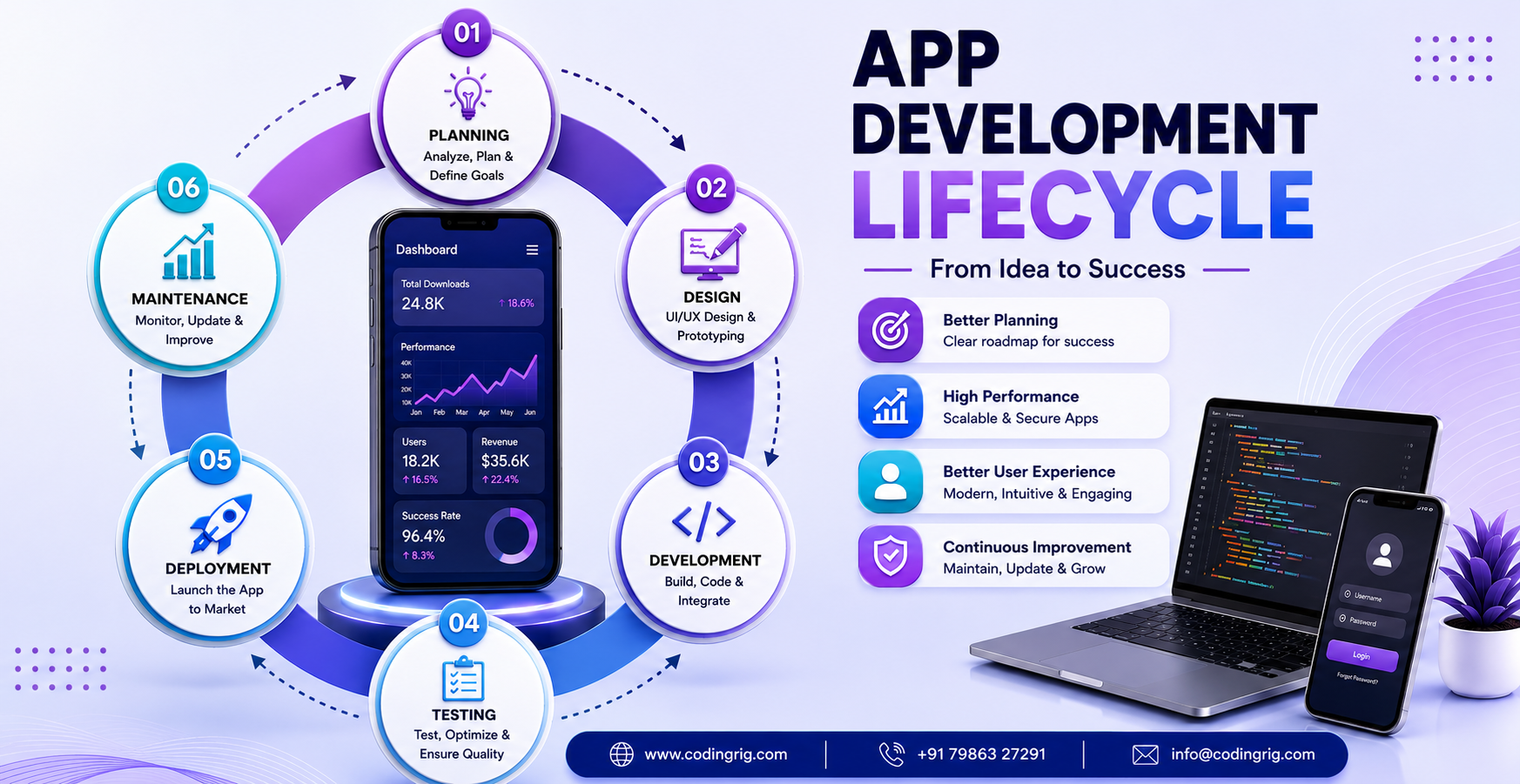
App Development Lifecycle: A Complete Guide to Building High-Performance Mobile Applications
In today's digital-first world, mobile applications have become an essential part of business growth. Whether you're launching a startup, managing an enterprise, or expanding your online services, a well-designed mobile app can improve customer engagement, increase revenue, and strengthen your brand presence. However, creating a successful application involves much more than coding. It requires a strategic and structured App Development Lifecycle that ensures quality, performance, and long-term scalability.
At Coding Rig, we follow a proven app development process that transforms innovative ideas into feature-rich, secure, and scalable mobile applications.
Why Is the App Development Lifecycle Important?
Many businesses focus only on the final product, but the development journey determines the application's success. A well-defined lifecycle helps teams minimize risks, reduce development costs, improve collaboration, and deliver applications that meet both user expectations and business objectives.
A structured process also makes it easier to adapt to changing market trends, incorporate customer feedback, and maintain application performance after launch.
Stage 1: Planning & Requirement Analysis
Every successful application begins with a clear strategy. During the planning phase, developers and stakeholders work together to understand business goals, target audiences, and technical requirements.
This stage includes:
- Business requirement analysis
- Competitor research
- User persona creation
- Feature prioritization
- Budget estimation
- Technology selection
- Project roadmap
A strong foundation reduces future development challenges and ensures the project stays aligned with business objectives.
Stage 2: UI/UX Design
Design plays a critical role in user satisfaction. A visually appealing and intuitive interface encourages users to interact with the application and improves retention rates.
The design phase focuses on:
- User journey mapping
- Wireframing
- Interactive prototypes
- Visual interface design
- Brand consistency
- Responsive layouts
- Accessibility standards
An excellent UI/UX design creates a seamless experience across Android, iOS, tablets, and other devices.
Stage 3: Application Development
Once the design is approved, developers begin building the application using modern technologies and best coding practices.
Depending on business requirements, developers may choose:
- Native Android Development
- Native iOS Development
- Flutter Development
- React Native Development
- Progressive Web Apps (PWAs)
During this phase, developers integrate:
- APIs
- Payment gateways
- Authentication systems
- Push notifications
- Cloud storage
- Analytics
- Security features
Following clean coding standards ensures the application remains scalable and easy to maintain.
Stage 4: Quality Assurance & Testing
Testing is one of the most important phases of the App Development Lifecycle. Even a well-designed application can fail if bugs affect the user experience.
Comprehensive testing includes:
- Functional testing
- UI testing
- Performance testing
- Security testing
- Compatibility testing
- Device testing
- User Acceptance Testing (UAT)
The objective is to identify and resolve issues before the application reaches end users, ensuring stability, security, and smooth performance.
Stage 5: Deployment & Launch
After successful testing, the application is prepared for launch on app stores or enterprise platforms.
This phase includes:
- Store optimization
- App submission
- Compliance verification
- Performance monitoring
- Production deployment
A carefully managed launch ensures users can access the application without technical issues while maximizing visibility in app marketplaces.
Stage 6: Maintenance & Continuous Improvement
Launching an application is only the beginning. Regular maintenance ensures the app remains secure, compatible with new operating systems, and capable of meeting evolving customer expectations.
Maintenance activities include:
- Bug fixes
- Security updates
- Feature enhancements
- Performance optimization
- Cloud infrastructure monitoring
- User feedback implementation
- Analytics-driven improvements
Businesses that continuously improve their applications achieve higher customer satisfaction and long-term growth.
Emerging Trends in App Development
The mobile app industry continues to evolve rapidly. Modern applications now integrate advanced technologies that improve efficiency and user engagement.
Some of the latest trends include:
- Artificial Intelligence (AI)
- Machine Learning
- Augmented Reality (AR)
- Internet of Things (IoT)
- Blockchain Integration
- Voice Search
- Cloud Computing
- 5G Optimization
- Predictive Analytics
- Advanced Cybersecurity
Businesses adopting these innovations gain a competitive advantage while delivering smarter digital experiences.
Best Practices for a Successful App Development Lifecycle
To maximize project success, businesses should:
- Define clear objectives before development.
- Prioritize user experience.
- Build scalable architecture.
- Follow agile development methodologies.
- Perform continuous testing.
- Implement robust security measures.
- Monitor application performance after launch.
- Regularly update features based on user feedback.
These practices help reduce technical debt and ensure long-term application reliability.
Why Choose Coding Rig?
At Coding Rig, we combine creativity, technical expertise, and industry best practices to deliver custom mobile applications that help businesses grow. Our team specializes in Android, iOS, Flutter, React Native, and enterprise application development.
From strategy and design to deployment and ongoing maintenance, we provide end-to-end app development solutions tailored to your business goals.
Whether you're building a startup MVP, a customer-facing mobile app, or a complex enterprise platform, Coding Rig delivers secure, scalable, and future-ready applications that drive measurable results.
Conclusion
The App Development Lifecycle is more than a sequence of technical steps—it is a strategic framework that transforms ideas into successful digital products. By following a structured process that includes planning, design, development, testing, deployment, and continuous maintenance, businesses can launch high-quality applications that deliver exceptional user experiences and long-term value.
As mobile technology continues to evolve, investing in a well-planned development lifecycle ensures your application remains competitive, secure, and ready for future growth. If you're looking to build a powerful mobile app, partnering with an experienced development team like Coding Rig can help turn your vision into reality.