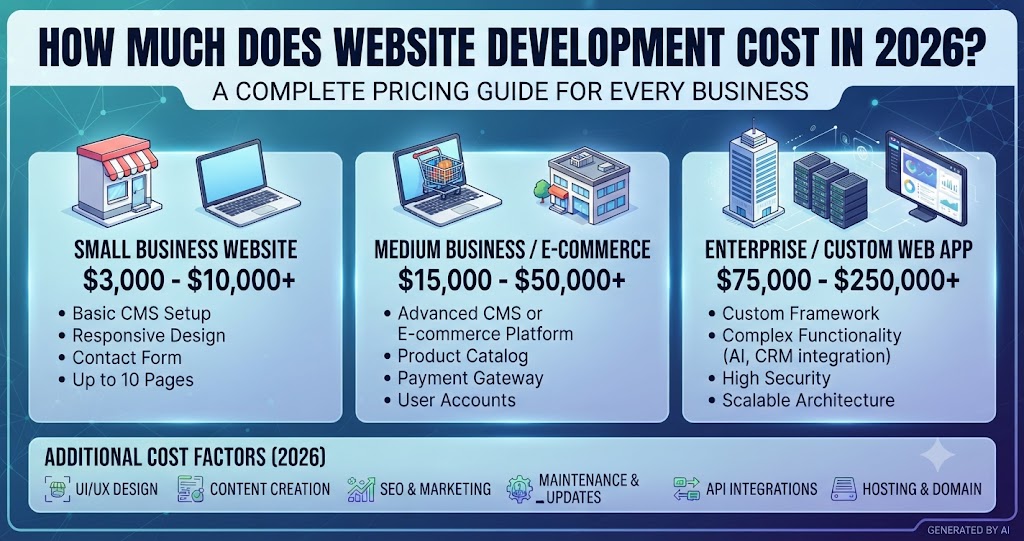
How Much Does Website Development Cost in 2026? A Complete Pricing Guide for Every Business
A professional website is no longer just a digital brochure—it's the foundation of your online presence. Whether you're launching a startup, growing a local business, or expanding an enterprise, your website plays a crucial role in attracting customers, building trust, and generating revenue.
One of the first questions every business owner asks is, "How much does website development cost?" The answer isn't always straightforward because every website has unique goals, features, and technical requirements.
In 2026, website development costs vary depending on design complexity, functionality, integrations, security, content, and long-term maintenance. Understanding these factors helps businesses plan their budgets wisely and invest in a website that delivers measurable results.
This guide explains what influences website pricing, different types of websites, ongoing costs, and how to choose the right development partner.
Why Website Development Costs Vary
No two websites are exactly alike. A simple informational website requires significantly less time and development than an eCommerce platform, customer portal, or enterprise application.
Several factors affect the final development cost, including:
- Number of web pages
- Custom UI/UX design
- Mobile responsiveness
- Content Management System (CMS)
- E-commerce functionality
- Third-party integrations
- Custom features
- SEO optimization
- Website security
- Performance optimization
- Hosting requirements
- Ongoing maintenance
The more customized and feature-rich a website becomes, the higher the development effort.
Website Development Cost by Website Type
Understanding the different categories of websites makes budgeting much easier.
Business Website
A business website typically includes a homepage, about page, service pages, contact page, blog, and inquiry forms. It is ideal for companies that want to establish credibility and generate leads online.
These websites focus on responsive design, fast loading speed, and SEO-friendly architecture.
E-Commerce Website
Online stores require additional functionality such as product catalogs, shopping carts, payment gateways, inventory management, customer accounts, shipping integration, and order tracking.
Because of these advanced features, eCommerce websites require more planning, testing, and ongoing support.
Portfolio Website
Freelancers, designers, photographers, architects, consultants, and agencies often choose portfolio websites to showcase their work and attract new clients.
These websites prioritize clean design, galleries, testimonials, and contact forms.
Corporate Website
Large organizations often require corporate websites featuring multiple departments, multilingual support, investor information, career portals, news sections, and advanced security.
Enterprise-level functionality increases both development complexity and project timelines.
Custom Web Application
Some businesses require more than a standard website. Customer dashboards, CRM systems, ERP portals, booking platforms, HRMS software, learning management systems, and inventory management solutions are examples of custom web applications.
These projects involve detailed planning, custom programming, database architecture, API integration, and user authentication.
What Factors Influence Website Development Pricing?
Custom Design
A professionally designed website reflects your brand identity and improves user experience. Custom layouts generally require more time than using pre-built templates but provide greater flexibility and uniqueness.
Responsive Development
Modern websites must perform seamlessly across desktops, tablets, and smartphones. Responsive development ensures users enjoy a consistent experience regardless of their device.
Content Management System
Many businesses prefer CMS platforms that allow them to update content without technical knowledge. Choosing the right CMS can influence development time and future maintenance.
SEO Optimization
Search engine optimization should be built into the website from the beginning. Proper site structure, clean URLs, schema markup, optimized images, metadata, and fast loading speeds contribute to better search visibility.
Website Speed
Performance optimization includes image compression, code minification, caching, CDN implementation, and Core Web Vitals improvements. Faster websites provide better user experiences and stronger SEO performance.
Security Features
SSL certificates, secure login systems, firewalls, malware protection, data encryption, automated backups, and regular updates protect business and customer information.
Third-Party Integrations
Many businesses connect their websites with CRM software, payment gateways, email marketing platforms, accounting software, WhatsApp, live chat, analytics tools, and cloud services. These integrations increase development effort but improve operational efficiency.
Hidden Costs Businesses Should Consider
Website development is only part of the total investment. Businesses should also budget for ongoing services that keep the website secure, updated, and performing well.
Common recurring expenses include:
- Domain registration
- Web hosting
- SSL certificates
- Website maintenance
- Software updates
- Security monitoring
- Content creation
- SEO services
- Backup solutions
- Technical support
- Performance optimization
Planning for these ongoing costs helps avoid unexpected expenses after launch.
How to Choose the Right Website Development Company
Choosing the cheapest option often results in poor performance, security issues, and expensive redesigns later.
When selecting a development company, evaluate:
- Portfolio quality
- Industry experience
- Technical expertise
- Client reviews
- SEO knowledge
- Mobile optimization
- Security practices
- Support services
- Communication process
- Post-launch maintenance
A reliable development partner focuses on creating long-term business value rather than simply delivering a website.
Website Development Trends in 2026
Businesses increasingly expect websites to deliver intelligent, personalized, and interactive experiences.
Some of the latest trends include:
- AI-powered chatbots
- Progressive Web Apps (PWAs)
- Voice search optimization
- Dark mode interfaces
- Interactive animations
- Cloud hosting
- Headless CMS architecture
- Advanced cybersecurity
- Accessibility-first design
- Personalized customer experiences
Investing in future-ready technologies helps businesses remain competitive in an evolving digital landscape.
Why Investing in a Professional Website Pays Off
A professionally developed website is one of the highest-return investments a business can make. It works around the clock to attract visitors, generate leads, showcase products, answer customer questions, and support online sales.
Unlike traditional advertising, a well-optimized website continues delivering value over time through search engine traffic, improved brand credibility, and better customer engagement.
Businesses that prioritize quality over short-term cost often achieve stronger long-term growth.
How Coding Rig Builds Business-Focused Websites
At Coding Rig, we develop secure, scalable, and SEO-friendly websites tailored to each client's goals. Whether you need a corporate website, eCommerce platform, custom web application, healthcare portal, educational platform, or enterprise solution, our team focuses on performance, responsive design, security, and user experience.
Our websites are built with clean code, optimized for Core Web Vitals, and designed to support future business growth. From planning and UI/UX design to development, testing, deployment, and ongoing maintenance, we provide complete website development services that help businesses succeed online.
Conclusion
Website development costs in 2026 depend on far more than the number of pages. Features, functionality, security, integrations, design quality, and future scalability all influence the final investment.
Instead of asking, "What's the cheapest website available?", businesses should ask, "What kind of website will help us grow?"
A professionally developed website is an investment in your brand, customer experience, and long-term success. By understanding the factors that influence pricing and partnering with an experienced development company, businesses can create a website that delivers lasting value for years to come.