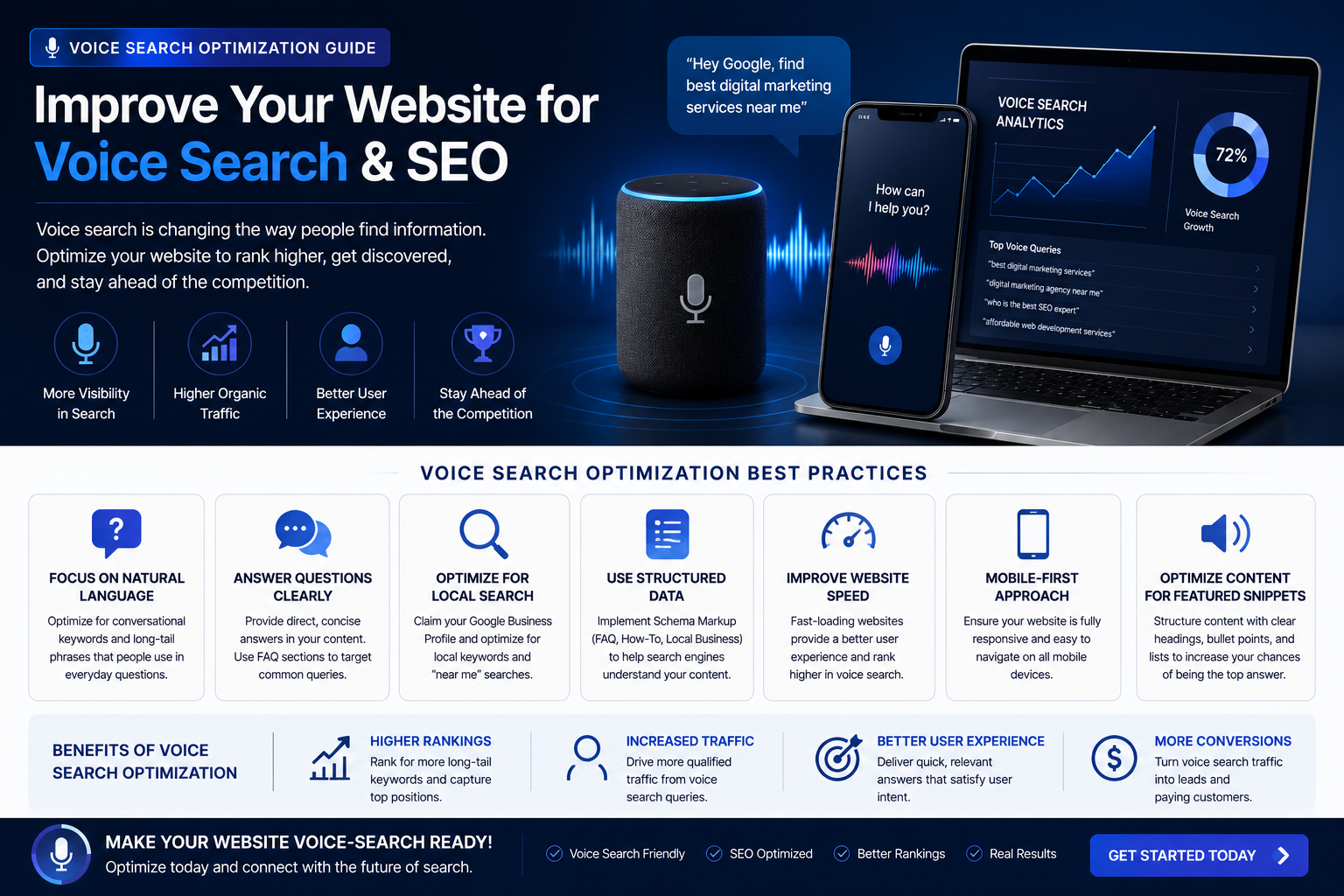
Voice Search Optimization Guide: Everything You Need to Know
Introduction
Voice search is transforming the way people find information online. Instead of typing short keywords into a search engine, users now ask complete questions using virtual assistants like Google Assistant, Siri, Alexa, and Cortana. As smart speakers, smartphones, and AI-powered devices become more common, voice search continues to grow in popularity.
For businesses, this shift means websites must be optimized not only for traditional search engines but also for conversational, question-based searches. Voice Search Optimization (VSO) focuses on making your content easy for search engines and AI assistants to understand and present as direct answers.
In this guide, you'll learn what voice search optimization is, why it matters, and the best practices to help your website stay competitive in 2026.
What Is Voice Search Optimization?
Voice Search Optimization is the process of improving your website so it can appear in voice search results. Unlike traditional SEO, which often targets short keywords, voice search optimization emphasizes natural language, conversational phrases, and direct answers to users' questions.
For example:
Typed Search:
- Best web development company
Voice Search:
- "Which company offers the best web development services near me?"
Optimizing for these conversational queries increases the likelihood that your content will be selected as a spoken response by voice assistants.
Why Voice Search Matters
Voice search is becoming an essential part of digital marketing because it offers users a faster and more convenient way to access information.
Benefits of optimizing for voice search include:
- Improved search visibility
- Better user experience
- Increased website traffic
- Higher local search visibility
- Greater chances of appearing in featured snippets
- Enhanced accessibility for users
Businesses that adapt early are better positioned to reach customers using voice-enabled devices.
How Voice Search Works
When a user asks a question, voice assistants:
- Understand the spoken query.
- Interpret the user's intent using AI and natural language processing.
- Search for the most relevant answer.
- Read or display the best result.
Websites with clear, well-structured, and trustworthy content have a better chance of being selected.
Key Features of Voice Search Queries
Voice searches are typically:
- Longer than typed searches
- Conversational in tone
- Question-based
- Intent-driven
- Frequently local
For example:
- "Where can I find a web designer near me?"
- "How do I improve my website speed?"
- "What are Core Web Vitals?"
Understanding these patterns helps you create content that matches user behavior.
Best Practices for Voice Search Optimization
1. Focus on Conversational Keywords
Use phrases that reflect how people naturally speak.
Instead of targeting:
- Website development
Also include:
- How can I build a business website?
- What is the best website development company?
Long-tail keywords often perform better for voice search.
2. Answer Questions Clearly
Structure your content to answer common questions directly.
Include sections such as:
- What is...?
- How does...?
- Why is...?
- When should...?
- Who needs...?
Provide concise answers before expanding into more detail.
3. Optimize for Featured Snippets
Voice assistants often rely on featured snippets to answer questions.
To improve your chances:
- Use descriptive headings
- Write concise definitions
- Create numbered steps
- Use bullet lists where appropriate
- Include FAQ sections
4. Improve Website Speed
Fast websites provide a better user experience and are more likely to perform well in search.
Ways to improve speed:
- Compress images
- Minify CSS and JavaScript
- Enable browser caching
- Use a Content Delivery Network (CDN)
- Optimize hosting
Strong performance also supports better Core Web Vitals.
5. Make Your Website Mobile-Friendly
Many voice searches are performed on mobile devices.
Ensure your website:
- Uses responsive design
- Loads quickly
- Has readable text
- Features easy navigation
- Includes touch-friendly buttons
A mobile-first experience is essential for modern SEO.
6. Use Structured Data (Schema Markup)
Schema markup helps search engines understand your content.
Useful schema types include:
- FAQ
- Organization
- Product
- Local Business
- Article
- Review
- Breadcrumb
Structured data increases the likelihood of rich search results.
7. Create FAQ Pages
FAQ pages are ideal for voice search because they naturally answer common questions.
Examples:
- What services do you offer?
- How much does website development cost?
- How long does it take to build a website?
Use clear questions and direct answers.
8. Optimize for Local SEO
Many voice searches have local intent.
Examples:
- "Web developer near me"
- "Best digital agency in my city"
Improve local visibility by:
- Maintaining an accurate business profile
- Displaying contact information
- Including location-specific content
- Encouraging customer reviews
9. Write in Natural Language
Avoid keyword stuffing.
Instead, write content that sounds like a conversation.
Natural language is easier for both users and AI systems to understand.
10. Build Authority and Trust
Search engines prefer reliable sources.
Improve credibility by:
- Publishing accurate content
- Keeping information updated
- Citing trustworthy sources when appropriate
- Demonstrating expertise in your industry
High-quality content remains the foundation of successful SEO.
Voice Search and AI Search
Modern search is increasingly powered by AI. Many AI assistants summarize information from high-quality websites to answer user questions.
To improve visibility:
- Use clear headings
- Provide direct answers
- Cover topics comprehensively
- Keep information current
- Organize content logically
These practices support both voice search and AI-driven search experiences.
Common Mistakes to Avoid
Avoid these common voice SEO mistakes:
- Ignoring question-based keywords
- Slow website performance
- Poor mobile optimization
- Thin or incomplete content
- Missing FAQ sections
- Overusing keywords
- Neglecting local SEO
- Failing to update content regularly
Correcting these issues improves both usability and search performance.
Benefits of Voice Search Optimization
Optimizing for voice search can help you:
- Increase organic traffic
- Reach mobile users
- Improve search visibility
- Enhance user experience
- Build trust with customers
- Support local business discovery
- Increase engagement
- Future-proof your SEO strategy
As voice technology continues to evolve, these benefits become even more valuable.
Frequently Asked Questions (FAQs)
What is Voice Search Optimization?
Voice Search Optimization is the process of improving your website so it can appear in results generated by voice assistants such as Google Assistant, Siri, and Alexa.
Why is voice search important?
Voice search offers users a faster, hands-free way to find information. Optimizing for it helps businesses reach people using conversational searches.
Does voice search affect SEO?
Yes. Voice search encourages content that is conversational, mobile-friendly, fast-loading, and structured to answer questions clearly.
How can I optimize my website for voice search?
Use natural language, target long-tail keywords, improve page speed, create FAQ sections, implement structured data, and optimize for mobile and local SEO.
Future of Voice Search
Voice search is expected to continue growing alongside AI-powered assistants and smart devices. Businesses that focus on creating helpful, conversational, and well-structured content will be better prepared for the future of search.
Rather than replacing traditional SEO, voice search optimization complements it by ensuring your content is accessible across a wider range of search experiences.
Conclusion
Voice Search Optimization is an important part of a modern SEO strategy. By focusing on conversational content, question-based keywords, fast website performance, mobile usability, and structured data, you can improve your chances of appearing in voice search results and AI-generated answers.
As user behavior evolves, optimizing for voice search helps your website remain relevant, discoverable, and ready for the next generation of search technology.