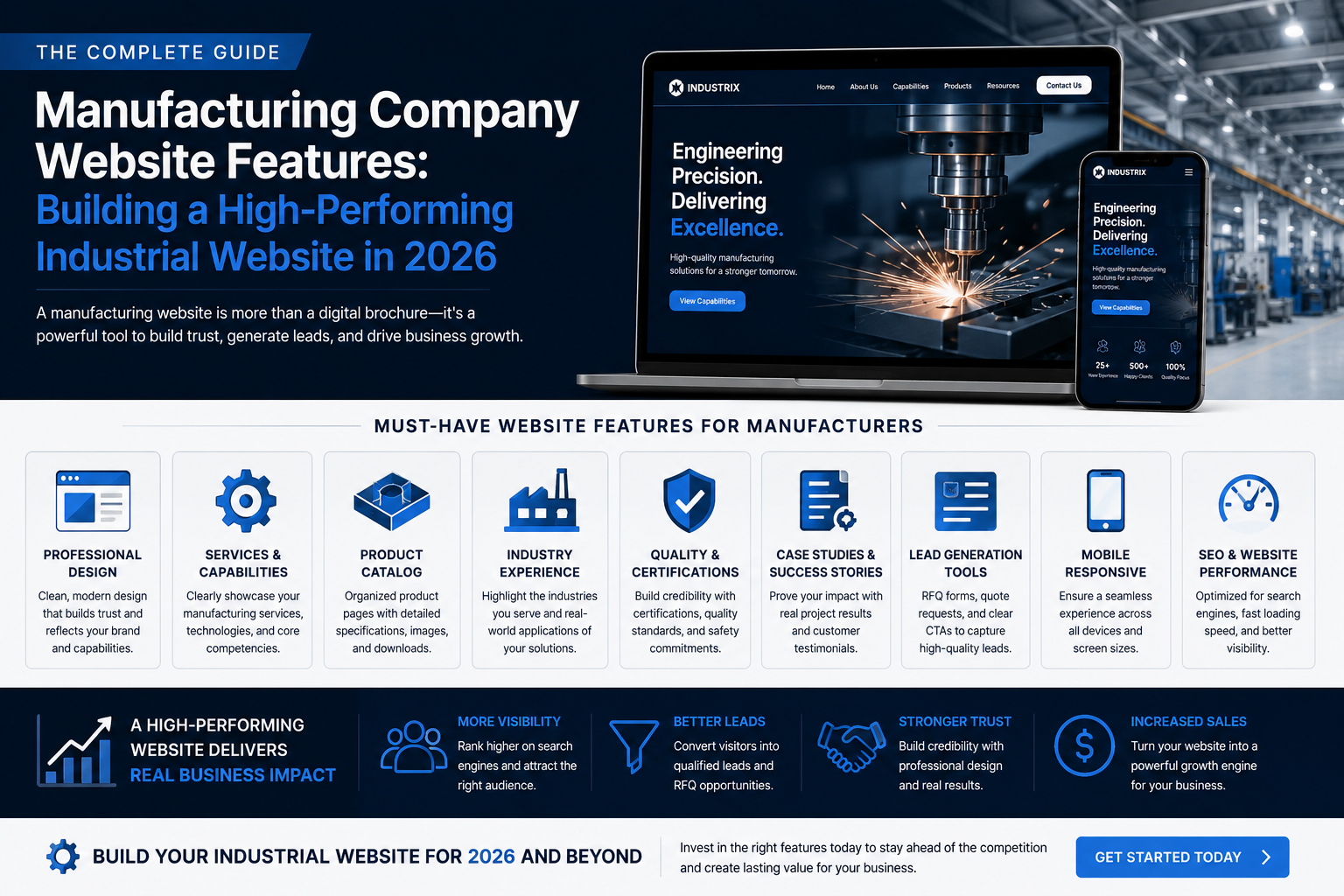
Manufacturing Company Website Features: Everything Your Industrial Business Needs Online
Introduction
In today's competitive manufacturing industry, your website is far more than a digital brochure—it's a powerful sales, marketing, and customer service tool. Whether you manufacture industrial machinery, automotive components, electronics, textiles, chemicals, packaging materials, or custom products, your website is often the first interaction potential clients have with your business.
Modern B2B buyers conduct extensive online research before contacting suppliers. They compare products, review certifications, explore manufacturing capabilities, and evaluate trustworthiness. A well-designed manufacturing website can showcase your expertise, generate qualified leads, improve customer confidence, and support long-term business growth.
This comprehensive guide explains the must-have features every manufacturing company website should include to stay competitive in 2026 and beyond.
Why Every Manufacturing Company Needs a Professional Website
Manufacturers no longer rely solely on trade shows, printed catalogs, or sales representatives. Today's customers expect instant access to company information, technical documentation, product specifications, and contact details.
A professional website helps manufacturers:
- Reach international markets
- Generate qualified business leads
- Build trust and credibility
- Showcase manufacturing capabilities
- Display certifications and compliance
- Support distributors and partners
- Improve search engine visibility
- Increase sales opportunities
Your website works around the clock, making it one of the most valuable investments for your business.
1. Professional Homepage
The homepage creates the first impression for potential clients.
An effective manufacturing homepage should include:
- Clear company introduction
- Strong value proposition
- High-quality industrial imagery
- Featured products
- Manufacturing capabilities
- Industries served
- Certifications
- Contact information
- Call-to-action buttons
Visitors should understand within seconds what your company manufactures and why they should choose you.
2. Company Profile
Your About Us page should communicate your experience and credibility.
Include information such as:
- Company history
- Mission and vision
- Manufacturing expertise
- Factory location
- Team members
- Infrastructure
- Years of experience
- Global presence
This helps establish trust with potential buyers.
3. Product Catalog
A comprehensive product catalog is one of the most important sections of a manufacturing website.
Each product page should contain:
- Product images
- Technical specifications
- Dimensions
- Material details
- Applications
- Features
- Benefits
- Downloads
- Product inquiry form
Well-organized product categories make it easier for customers to find what they need.
4. Manufacturing Capabilities
Showcase your production strengths.
Include details such as:
- CNC machining
- Injection molding
- Metal fabrication
- Sheet metal processing
- Assembly
- Welding
- Quality inspection
- Custom manufacturing
- Packaging
- Logistics
Explain the technologies, equipment, and processes you use.
5. Industry Solutions
Instead of focusing only on products, explain how your solutions serve different industries.
Examples include:
- Automotive
- Construction
- Healthcare
- Aerospace
- Agriculture
- Electronics
- Food processing
- Energy
- Packaging
- Pharmaceuticals
This helps potential customers understand your expertise in their sector.
6. Certifications & Quality Standards
Manufacturing buyers look for quality assurance.
Display certifications such as:
- ISO 9001
- ISO 14001
- CE Marking
- RoHS Compliance
- FDA Approval (where applicable)
- Industry-specific certifications
Include certification logos, descriptions, and downloadable certificates if appropriate.
7. Factory Gallery
Visual content builds confidence.
Include:
- Factory photos
- Production lines
- Machinery
- Warehouse
- Quality control
- Packaging area
- Team members
- Office facilities
Professional images demonstrate transparency and capability.
8. Videos
Manufacturing videos significantly increase engagement.
Useful videos include:
- Factory tours
- Product demonstrations
- Manufacturing processes
- Machine operations
- Customer testimonials
- Installation guides
Videos help buyers better understand your products and operations.
9. Download Center
Provide downloadable resources such as:
- Product catalogs
- Brochures
- Technical data sheets
- User manuals
- Installation guides
- Safety documents
- CAD drawings
- Certificates
Easy access to documentation supports purchasing decisions.
10. Advanced Search
Manufacturing websites often contain hundreds of products.
A powerful search function allows visitors to search by:
- Product name
- SKU
- Material
- Size
- Industry
- Application
- Category
This improves usability and saves time.
11. Product Filters
Filters help customers narrow down product options.
Examples:
- Material
- Dimensions
- Industry
- Application
- Brand
- Product type
- Price (if displayed)
12. Request for Quote (RFQ)
Many manufacturing purchases begin with a quote request.
An RFQ form should allow users to submit:
- Product requirements
- Quantity
- Specifications
- Drawings
- Delivery location
- Timeline
- Contact information
This simplifies the inquiry process.
13. Contact Forms
Make it easy for customers to reach you.
Include:
- General inquiry form
- Sales inquiry
- Technical support
- Distributor application
- Career inquiries
Short, user-friendly forms encourage more submissions.
14. Live Chat
Live chat enables instant communication with potential customers.
Benefits include:
- Faster responses
- Improved customer satisfaction
- Better lead qualification
- Increased conversions
AI-powered chatbots can also answer common questions outside business hours.
15. Customer Testimonials
Social proof builds trust.
Include:
- Client reviews
- Success stories
- Case studies
- Industry partnerships
- Long-term customer relationships
Authentic testimonials reassure potential buyers.
16. Case Studies
Show real-world examples of your work.
A case study should explain:
- Customer challenge
- Your solution
- Products supplied
- Results achieved
- Customer feedback
Case studies demonstrate expertise and problem-solving capabilities.
17. Blog & Knowledge Center
Publishing educational content helps attract organic traffic and position your company as an industry expert.
Topics may include:
- Manufacturing trends
- Product guides
- Industry regulations
- Maintenance tips
- Material comparisons
- Technology innovations
- Sustainability practices
Regular updates improve SEO and keep your audience engaged.
18. Mobile-Friendly Design
Many buyers browse on mobile devices.
Your website should offer:
- Responsive layouts
- Easy navigation
- Fast loading
- Click-to-call buttons
- Readable text
- Optimized forms
A seamless mobile experience supports both user satisfaction and search performance.
19. Fast Website Performance
Website speed directly impacts user experience.
Improve performance by:
- Compressing images
- Using modern image formats
- Implementing caching
- Using a CDN
- Optimizing code
- Reducing unnecessary scripts
Fast-loading websites encourage visitors to explore more pages.
20. Search Engine Optimization (SEO)
A manufacturing website should be optimized for search engines to attract qualified leads.
SEO best practices include:
- Keyword research
- Optimized page titles
- Meta descriptions
- Heading hierarchy
- Internal linking
- Image optimization
- Schema markup
- XML sitemap
- Quality content
- Technical SEO
Strong SEO helps your products and services appear in relevant search results.
21. Security Features
Protect customer data with:
- SSL certificate (HTTPS)
- Secure hosting
- Regular backups
- Firewall protection
- Malware scanning
- Software updates
- Access controls
A secure website builds confidence and safeguards business operations.
22. Integration with Business Tools
Modern manufacturing websites often connect with:
- CRM systems
- ERP software
- Inventory management
- Email marketing platforms
- Analytics tools
- Marketing automation
- Customer support systems
These integrations streamline operations and improve efficiency.
23. Analytics and Performance Tracking
Monitor website performance using analytics tools to understand:
- Visitor behavior
- Traffic sources
- Popular products
- Conversion rates
- Quote requests
- Bounce rates
Data-driven insights help you refine your marketing strategy.
Common Mistakes Manufacturing Websites Should Avoid
- Outdated design
- Slow loading pages
- Poor navigation
- Missing product details
- No mobile optimization
- Broken links
- Weak calls to action
- Low-quality images
- Lack of SEO
- Difficult contact process
Avoiding these issues creates a more professional and effective website.
Benefits of a Feature-Rich Manufacturing Website
A modern manufacturing website can:
- Increase brand credibility
- Generate more qualified leads
- Support global expansion
- Improve customer communication
- Showcase technical expertise
- Enhance customer service
- Strengthen SEO performance
- Boost conversion rates
- Reduce sales cycle time
- Drive long-term business growth
Frequently Asked Questions (FAQs)
Why is a manufacturing company website important?
It helps showcase products, build credibility, generate leads, and provide customers with the information they need to make purchasing decisions.
What should a manufacturing website include?
Essential features include a product catalog, company profile, manufacturing capabilities, certifications, RFQ forms, case studies, contact information, and SEO-optimized content.
How does SEO help manufacturing companies?
SEO improves online visibility, attracts targeted visitors, and increases inquiries from businesses searching for manufacturing products or services.
Should manufacturing websites be mobile-friendly?
Yes. A responsive, mobile-friendly website improves user experience and supports better search engine rankings.
Conclusion
A manufacturing company’s website is a vital business asset that supports marketing, sales, customer service, and brand reputation. By incorporating essential features such as detailed product catalogs, RFQ forms, certifications, case studies, fast performance, mobile responsiveness, and SEO best practices, manufacturers can create an online presence that attracts qualified leads and builds lasting customer trust.
Investing in a professional, feature-rich website ensures your business remains competitive in an increasingly digital marketplace.