Inventory Management Software: Benefits, Features & Complete Guide for Businesses (2026)
Introduction
Effective inventory management is essential for any business that deals with physical products. Whether you operate a retail store, warehouse, manufacturing unit, pharmacy, or eCommerce business, maintaining the right inventory levels directly impacts profitability and customer satisfaction. Too much stock increases storage costs and ties up working capital, while insufficient inventory can result in missed sales and unhappy customers.
In 2026, businesses need more than spreadsheets or manual stock records. They require a smart inventory management system that provides real-time visibility, automates stock tracking, and integrates with other business applications. Inventory Management Software helps businesses improve efficiency, reduce errors, optimize purchasing decisions, and streamline daily operations.
This guide explains how inventory management software works, its key features, benefits, industry applications, and why it has become a must-have solution for modern businesses.
What is Inventory Management Software?
Inventory Management Software is a digital system that helps businesses monitor, organize, and control inventory throughout the supply chain. It tracks products from purchasing and receiving to storage, sales, returns, and replenishment.
The software automatically updates stock levels whenever products are bought, sold, transferred, or returned, ensuring businesses always have accurate inventory information. Modern inventory solutions also integrate with ERP systems, accounting software, CRM platforms, POS systems, barcode scanners, and eCommerce websites to create a connected business ecosystem.
Why Inventory Management Is Important
Inventory directly affects business performance. Poor inventory control often leads to stock shortages, overstocking, delayed deliveries, and unnecessary operational costs.
A reliable inventory management system helps businesses:
-
Track inventory accurately
-
Prevent stock shortages and overstocking
-
Improve warehouse efficiency
-
Speed up order fulfillment
-
Reduce inventory losses
-
Improve purchasing decisions
-
Increase customer satisfaction
-
Strengthen cash flow management
By automating routine inventory tasks, businesses can focus more on growth and customer service.
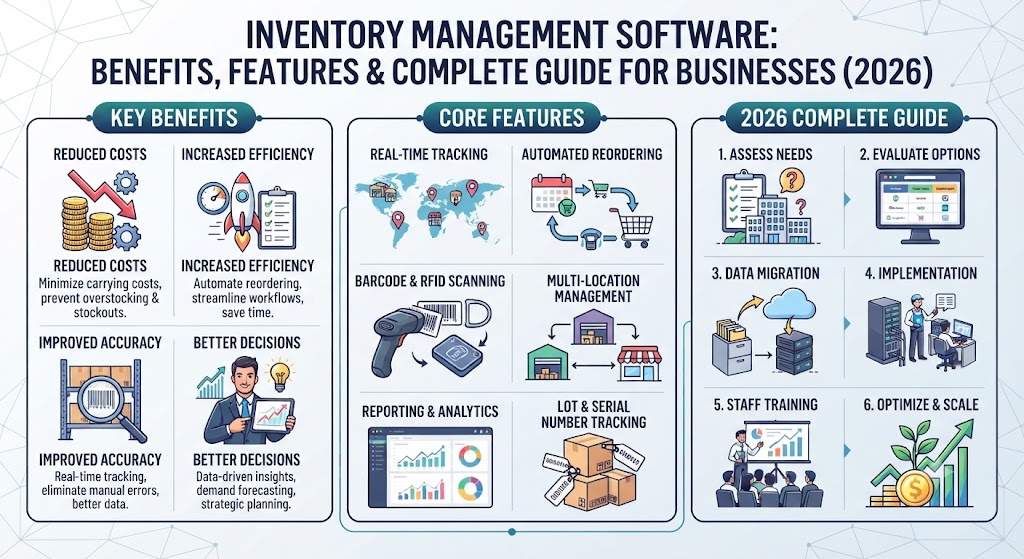
Key Features of Inventory Management Software
A modern inventory management system offers several powerful features designed to improve operational efficiency.
Real-Time Inventory Tracking
Monitor stock levels instantly across warehouses, stores, and sales channels with automatic updates after every transaction.
Barcode & QR Code Integration
Barcode and QR code scanning speeds up stock counting, product identification, and order processing while minimizing manual errors.
Purchase Order Management
Create purchase orders, manage suppliers, receive inventory, and automatically update stock records when products arrive.
Sales & Order Management
Synchronize inventory with sales to ensure stock quantities are updated automatically after every completed order.
Multi-Warehouse Management
Track inventory across multiple warehouse locations, transfer stock efficiently, and monitor availability from a centralized dashboard.
Low Stock Alerts
Receive automatic notifications when inventory reaches minimum stock levels, helping prevent shortages.
Batch & Serial Number Tracking
Track products using batch or serial numbers for quality control, warranty management, and product traceability.
Reports & Analytics
Generate reports on inventory turnover, stock valuation, product performance, purchase history, and sales trends to support better business decisions.
Benefits of Inventory Management Software
Implementing inventory software offers numerous business advantages:
-
Improved inventory accuracy
-
Faster order fulfillment
-
Lower operational costs
-
Better demand forecasting
-
Reduced inventory waste
-
Increased productivity
-
Better customer satisfaction
-
Improved profitability
-
Stronger supply chain management
These benefits enable businesses to improve efficiency while reducing unnecessary expenses.
Industries That Use Inventory Management Software
Inventory software supports businesses across various industries, including:
-
Retail
-
eCommerce
-
Wholesale distribution
-
Manufacturing
-
Pharmaceuticals
-
Healthcare
-
Food & Beverage
-
Logistics
-
Automotive
-
Electronics
-
Construction
-
Educational Institutions
Any organization managing physical inventory can benefit from inventory automation.
Inventory Management Software vs Manual Tracking
Many businesses still rely on spreadsheets or paper-based inventory records. While this may work initially, it becomes inefficient as operations grow.
Manual inventory management often results in:
-
Data entry mistakes
-
Duplicate records
-
Missing inventory
-
Delayed stock updates
-
Time-consuming audits
-
Poor inventory visibility
Inventory management software eliminates these issues by providing real-time updates, automation, and centralized inventory control.
Inventory Management Trends in 2026
Technology continues to improve inventory management with advanced automation and intelligent analytics.
Important trends include:
-
AI-powered demand forecasting
-
RFID and IoT inventory tracking
-
Cloud-based inventory management
-
Mobile inventory applications
-
Automated warehouse operations
-
Predictive inventory analytics
-
Business Intelligence integration
-
Voice-enabled inventory control
-
Sustainable inventory planning
-
Real-time supply chain monitoring
Businesses adopting these innovations gain greater efficiency and better control over inventory.
Best Practices for Inventory Management
To maximize the value of inventory software, businesses should follow these best practices:
-
Perform regular inventory audits
-
Use barcode or QR code scanning
-
Set reorder points for products
-
Monitor inventory turnover
-
Identify slow-moving stock
-
Integrate inventory with accounting and sales systems
-
Maintain supplier records
-
Train employees regularly
-
Automate purchase planning
-
Review inventory reports frequently
Following these practices helps improve inventory accuracy and long-term operational efficiency.
Why Choose Coding Rig?
At Coding Rig, we build customized Inventory Management Software designed to simplify stock control and improve business efficiency. Our solutions include real-time inventory tracking, warehouse management, barcode integration, purchase and sales management, supplier management, reporting dashboards, mobile accessibility, cloud deployment, and secure user-role management.
We also integrate inventory software with ERP systems, POS solutions, accounting platforms, CRM software, eCommerce websites, and Business Intelligence tools, creating a complete digital ecosystem for your business.
Every solution is scalable, secure, and tailored to your operational requirements, helping you reduce costs, improve productivity, and maintain complete control over your inventory.
Conclusion
Inventory Management Software has become an essential tool for businesses in 2026. It improves stock accuracy, automates inventory processes, reduces operational costs, and provides real-time visibility across the entire supply chain.
Whether you operate a retail store, warehouse, manufacturing business, or eCommerce company, implementing a modern inventory management system helps increase efficiency, improve customer satisfaction, and support sustainable business growth. Investing in the right inventory solution today prepares your business for a smarter, more profitable future.