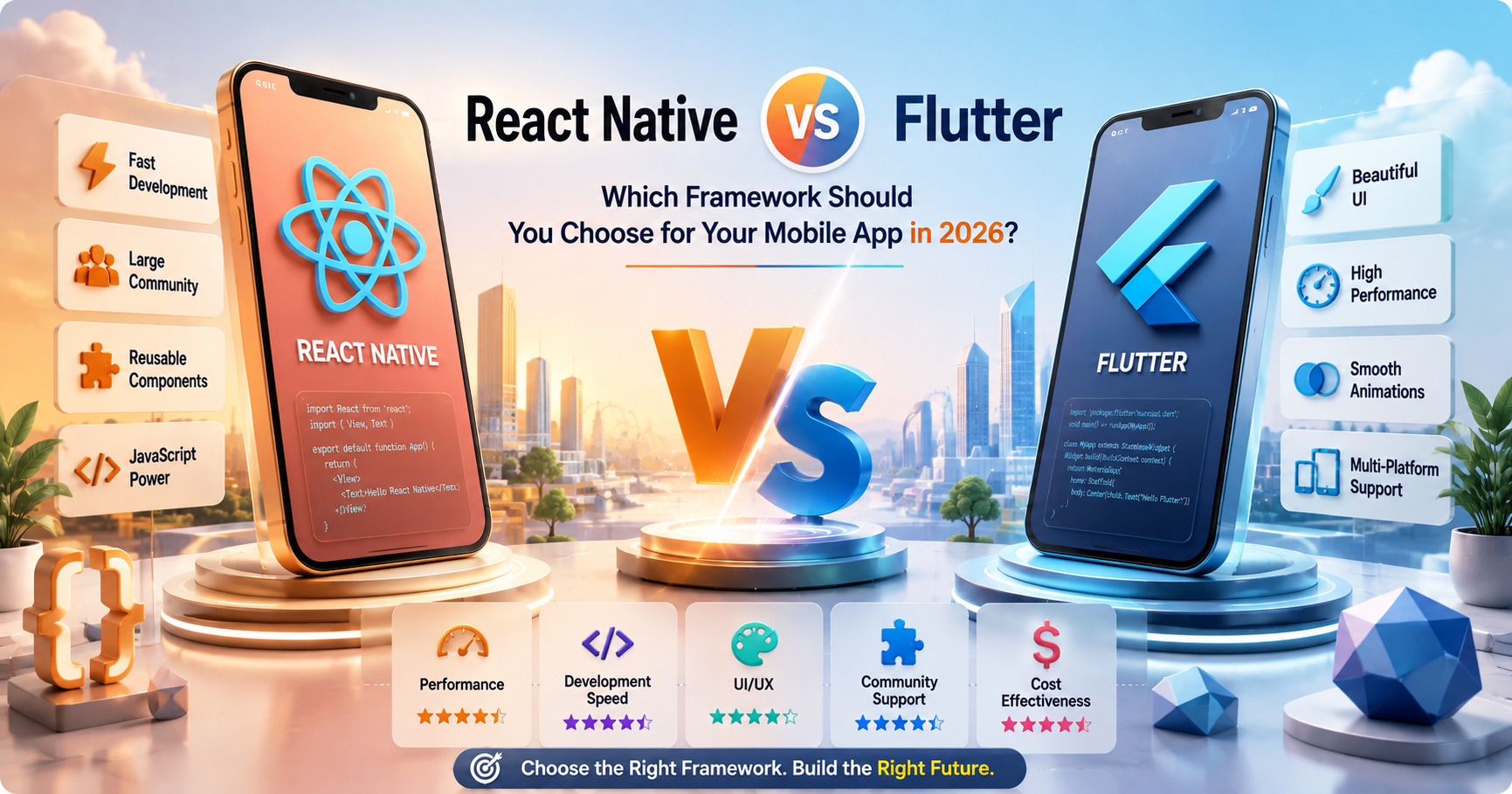
React Native vs Flutter: Which Framework Should You Choose for Your Mobile App in 2026?
The demand for mobile applications continues to grow in 2026 as businesses increasingly rely on digital solutions to connect with customers. Whether you're launching a startup, expanding an existing business, or building an enterprise application, selecting the right mobile app framework is one of the most important decisions you'll make.
Among all cross-platform technologies, React Native and Flutter remain the two most popular frameworks. Both allow developers to build Android and iOS applications using a single codebase, reducing development time and overall costs.
However, each framework has unique strengths, making it suitable for different types of projects. In this guide, we'll compare React Native and Flutter to help you determine which one best aligns with your business goals.
What is React Native?
React Native is an open-source framework developed by Meta that enables developers to build native-like mobile applications using JavaScript and React.
Instead of creating separate applications for Android and iOS, developers write a single codebase that works across both platforms.
Key Benefits of React Native
- Single codebase for Android and iOS
- Faster development process
- Large developer community
- Huge ecosystem of third-party libraries
- Easier maintenance
- Lower overall development costs
React Native is widely used for business apps, eCommerce platforms, CRM systems, social networking apps, healthcare solutions, and enterprise applications.
What is Flutter?
Flutter is Google's open-source UI toolkit that uses the Dart programming language to build highly responsive applications for mobile, web, and desktop.
Unlike React Native, Flutter includes its own rendering engine, giving developers complete control over the application's interface and animations.
Key Benefits of Flutter
- Beautiful and customizable UI
- Excellent performance
- Rich widget library
- Smooth animations
- Consistent user experience across devices
- Supports mobile, web, and desktop from one codebase
Flutter is ideal for businesses that prioritize modern design, interactive interfaces, and high-performance applications.
React Native vs Flutter: Feature Comparison
1. Development Speed
Both frameworks significantly reduce development time compared to native app development.
React Native benefits from JavaScript's popularity and a mature ecosystem, while Flutter offers Hot Reload, allowing developers to instantly view code changes.
Winner: Tie
2. Performance
Flutter generally delivers slightly better performance because it compiles directly into native ARM code and doesn't rely on JavaScript bridges.
React Native performs exceptionally well for most business applications but may require additional optimization for graphics-intensive apps.
Winner: Flutter
3. User Interface
Flutter provides extensive built-in widgets that enable developers to create visually appealing applications with consistent designs across all platforms.
React Native relies more on native components, making apps feel closer to each platform's native experience.
Winner: Flutter
4. Learning Curve
React Native uses JavaScript, one of the world's most widely used programming languages. Many developers already have experience with JavaScript and React.
Flutter uses Dart, which may require additional learning for developers unfamiliar with it.
Winner: React Native
5. Community Support
React Native has been around longer and has one of the largest developer communities.
Flutter's community continues to grow rapidly and receives strong support from Google.
Winner: React Native
6. Third-Party Libraries
React Native has a massive collection of plugins and packages due to its long-standing ecosystem.
Flutter has an expanding package ecosystem but still trails React Native in certain specialized integrations.
Winner: React Native
7. App Performance
For applications involving advanced animations, gaming features, or custom interfaces, Flutter often delivers smoother performance.
React Native performs exceptionally well for business applications, dashboards, marketplaces, and social apps.
Winner: Flutter
React Native is Best For
Choose React Native if your business needs:
- Business management applications
- CRM software
- Marketplace apps
- Social networking apps
- Healthcare applications
- Enterprise software
- eCommerce mobile apps
- Faster project delivery
- Easy maintenance
Flutter is Best For
Choose Flutter if your project requires:
- Highly interactive UI
- Custom animations
- Beautiful modern interfaces
- FinTech applications
- Travel applications
- Media streaming apps
- Educational platforms
- Premium user experiences
Cost Comparison
Since both frameworks use a single codebase, development costs are significantly lower than building separate Android and iOS applications.
The final project cost depends on:
- App complexity
- Number of features
- Third-party integrations
- Backend development
- Design requirements
- Testing and maintenance
For most businesses, both React Native and Flutter offer excellent long-term value by reducing development and maintenance expenses.
Which Framework Should You Choose?
There isn't a one-size-fits-all answer.
Choose React Native if:
- You need faster development.
- Your team already works with JavaScript.
- You want extensive third-party library support.
- You're building business-focused applications.
Choose Flutter if:
- You want stunning UI designs.
- Performance is your top priority.
- Your app requires advanced animations.
- You plan to target mobile, web, and desktop with a unified experience.
The best framework depends on your business goals, timeline, budget, and long-term scalability requirements.
Why Choose Coding Rig for Mobile App Development?
At Coding Rig, we specialize in developing high-performance mobile applications using both React Native and Flutter. Our experienced developers carefully analyze your business objectives before recommending the most suitable framework for your project.
What Makes Coding Rig Different?
- Custom mobile app development
- React Native & Flutter experts
- Android and iOS applications
- Modern UI/UX design
- Scalable architecture
- Secure backend integration
- API development and third-party integrations
- Agile development process
- Performance optimization
- Ongoing maintenance and technical support
Whether you're building a startup MVP, an enterprise application, or a customer-facing mobile solution, Coding Rig delivers scalable, secure, and future-ready applications that help businesses grow.
Frequently Asked Questions (FAQs)
1. Which is better, React Native or Flutter?
Both frameworks are excellent. React Native is ideal for business applications and faster development, while Flutter excels in performance and custom UI design.
2. Which framework offers better performance?
Flutter generally provides better performance because it compiles directly into native machine code and uses its own rendering engine.
3. Is React Native easier to learn?
Yes. Developers familiar with JavaScript and React can learn React Native quickly, making it a popular choice for many development teams.
4. Can both frameworks build Android and iOS apps?
Yes. Both React Native and Flutter support cross-platform development using a single codebase for Android and iOS.
5. Which framework is more cost-effective?
Both reduce development costs compared to native development because they eliminate the need to maintain separate codebases for Android and iOS.
6. Which framework should startups choose?
Startups often choose React Native for faster development and quicker market launches, while Flutter is a great option when UI quality and user experience are top priorities.
Conclusion
React Native and Flutter are both powerful frameworks capable of delivering high-quality mobile applications. React Native offers faster development, a mature ecosystem, and excellent business app capabilities, while Flutter provides exceptional performance, beautiful interfaces, and highly customizable user experiences.
Before making a decision, evaluate your project's requirements, expected growth, design preferences, and budget. Partnering with an experienced mobile app development company ensures you choose the right technology from the start and build an application that supports your long-term business success.