API Integration Services: Connect Business Systems & Automate Workflows
Modern businesses use multiple software applications to manage daily operations. Customer data may be stored in a CRM, invoices generated through accounting software, inventory managed in an ERP system, and orders received from an eCommerce platform. When these systems operate independently, employees often spend valuable time transferring information manually, increasing the risk of errors and slowing business processes.
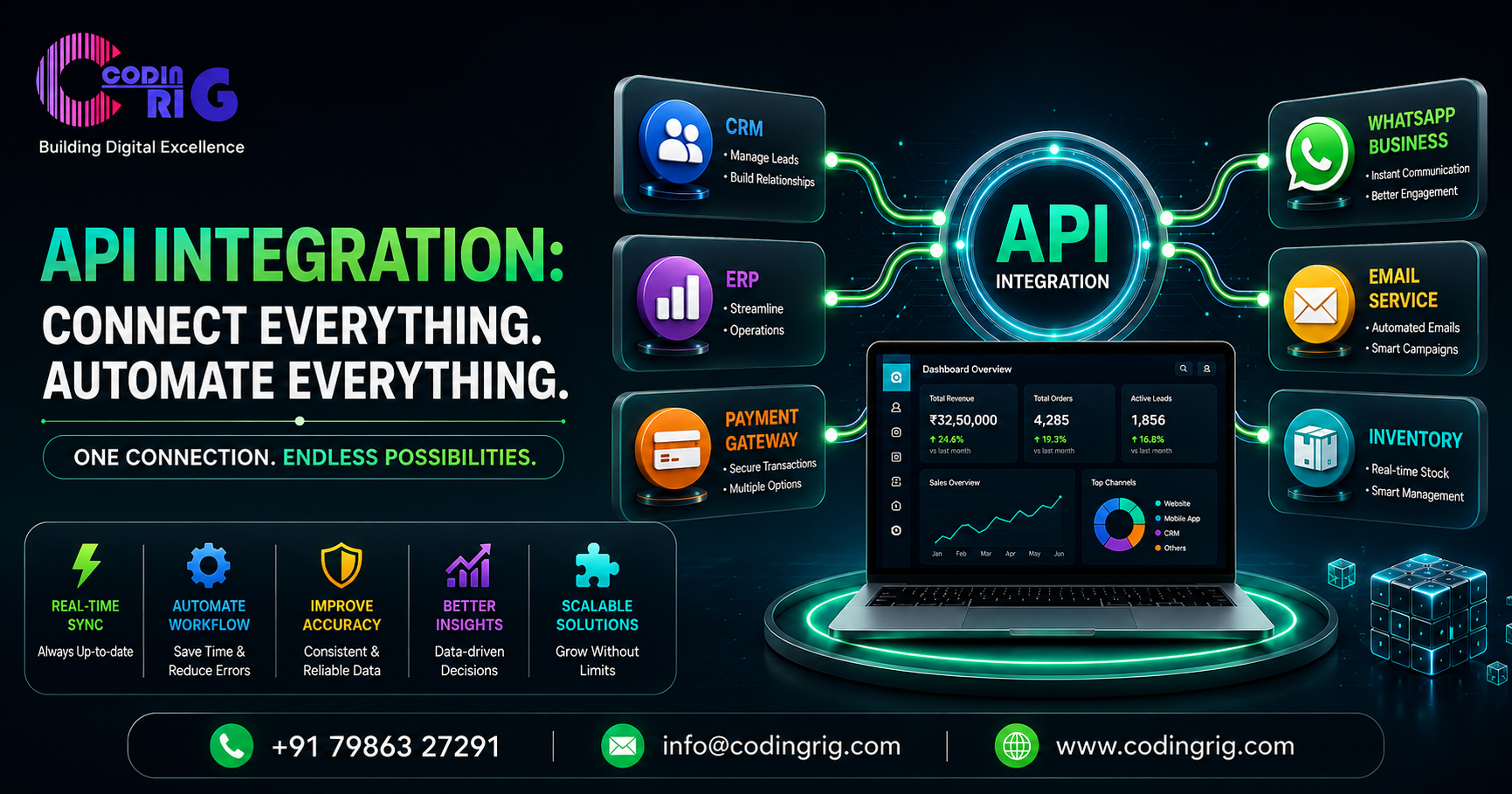
API integration solves this challenge by allowing different applications to communicate and exchange data automatically. Instead of working with disconnected systems, businesses create a unified digital ecosystem that improves efficiency, accuracy, and decision-making.
What Is API Integration?
API stands for Application Programming Interface. It is a technology that allows two or more software applications to communicate securely and exchange information in real time.
For example, when a customer places an order on your website, an API can automatically update your inventory, create an invoice, notify your CRM, and trigger a shipping request without requiring manual intervention.
API integration eliminates repetitive tasks and keeps business information synchronized across different platforms.
Why API Integration Is Important
As businesses grow, they often adopt multiple software solutions for different departments. Without integration, employees may need to enter the same information into several systems, leading to duplicate work and inconsistent data.
API integration helps businesses:
-
Automate routine workflows
-
Improve data accuracy
-
Eliminate manual data entry
-
Save time and operational costs
-
Increase productivity
-
Improve customer experiences
-
Enable faster business decisions
Connected systems allow teams to focus on strategic work instead of repetitive administrative tasks.
Common API Integration Use Cases
API integration is widely used across different industries and business functions.
Popular integrations include:
-
CRM and ERP systems
-
Payment gateways
-
eCommerce platforms
-
Inventory management software
-
HR and payroll systems
-
Accounting software
-
Email marketing platforms
-
SMS and WhatsApp notifications
-
Cloud storage services
-
Shipping and logistics systems
These integrations help businesses streamline operations while improving communication between applications.
Benefits of API Integration
Improved Business Efficiency
Automated workflows reduce manual work and allow employees to complete tasks faster. This improves productivity while reducing operational delays.
Real-Time Data Synchronization
Information entered into one system is automatically updated across connected applications, ensuring every department works with accurate and up-to-date data.
Better Customer Experience
Customers receive faster order confirmations, real-time updates, quicker support, and more accurate information because connected systems communicate instantly.
Increased Scalability
As your business grows, additional software and services can be integrated without rebuilding existing systems. API integration supports future expansion while maintaining operational efficiency.
Stronger Decision-Making
When data from multiple platforms is centralized, businesses gain better visibility into operations through accurate reporting and analytics.
Best Practices for Successful API Integration
Effective API integration requires careful planning and secure implementation.
Recommended practices include:
-
Clearly define business objectives.
-
Choose reliable APIs.
-
Implement secure authentication.
-
Encrypt sensitive data.
-
Monitor API performance.
-
Maintain proper documentation.
-
Test integrations thoroughly.
-
Plan for future scalability.
Following these practices helps ensure reliable and secure communication between systems.
API Integration and Digital Transformation
Digital transformation depends on connected technologies. Businesses that integrate their software systems can automate operations, reduce manual effort, and improve collaboration across departments.
Whether integrating cloud applications, mobile apps, websites, CRM platforms, ERP systems, or third-party services, API integration creates a seamless digital infrastructure that supports business growth.
Organizations with connected systems are often more agile, productive, and capable of adapting to changing market demands.
Industries That Benefit from API Integration
API integration delivers value across a wide range of industries, including:
-
eCommerce
-
Healthcare
-
Finance
-
Manufacturing
-
Logistics
-
Education
-
Real Estate
-
Hospitality
-
Retail
-
Professional Services
Regardless of industry, businesses can improve efficiency by connecting their software applications and automating workflows.
Why Choose Coding Rig?
At Coding Rig, we develop secure, scalable, and high-performance API integration solutions that connect your business systems and simplify operations. Our team specializes in integrating CRM, ERP, accounting software, payment gateways, cloud applications, mobile apps, websites, and third-party platforms into a unified ecosystem.
Whether you need custom API development, workflow automation, cloud integration, or enterprise software connectivity, we deliver reliable solutions tailored to your business needs. Every integration is built with security, performance, and scalability in mind to support long-term business growth.
Conclusion
API integration has become an essential part of modern business operations. By connecting applications and automating workflows, businesses can eliminate repetitive tasks, improve data accuracy, and increase overall productivity.
As organizations continue adopting digital technologies, seamless system integration provides a strong foundation for innovation and growth. Investing in professional API integration services helps businesses work smarter, deliver better customer experiences, and stay competitive in an increasingly connected digital world.