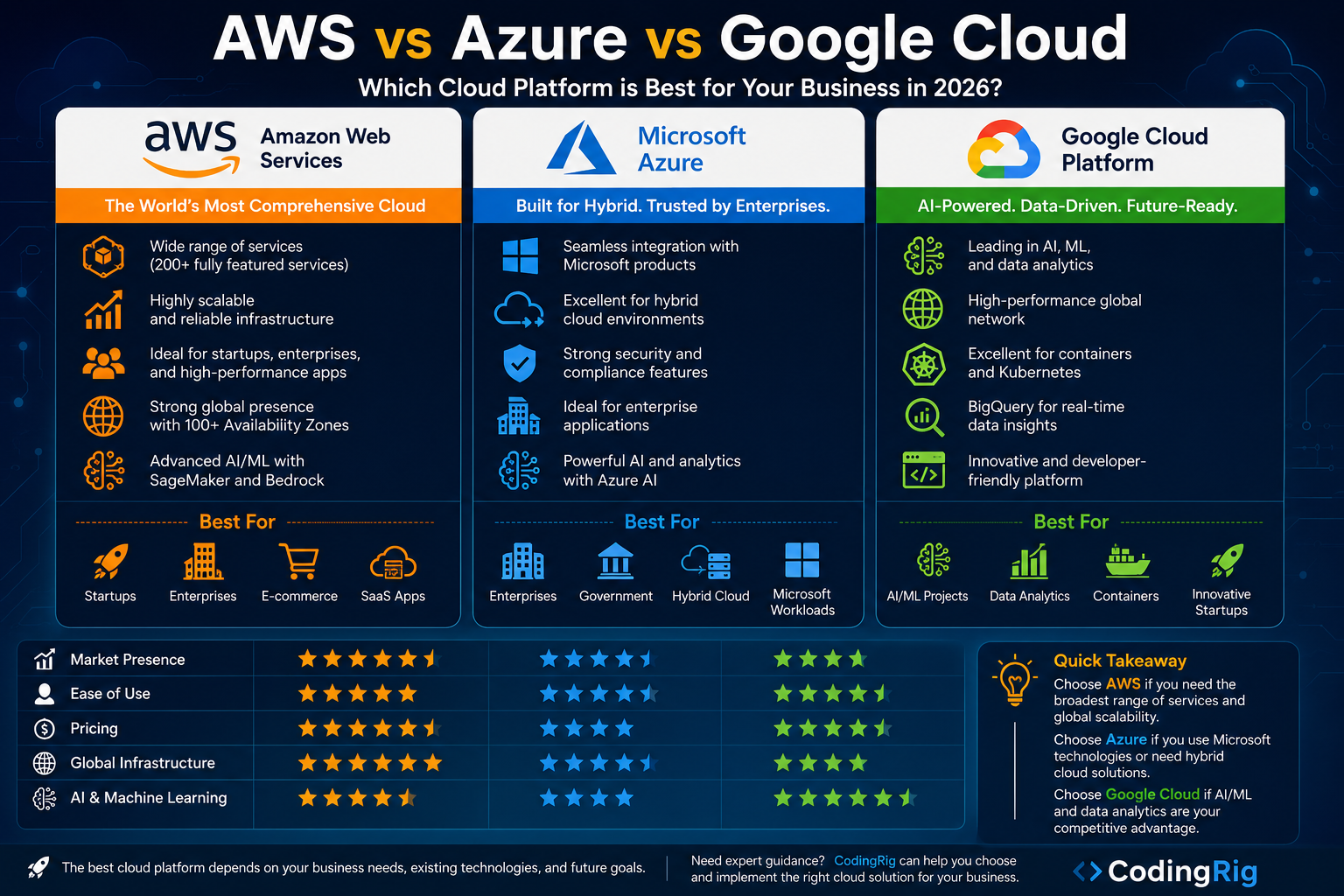
AWS vs Azure vs Google Cloud: Which Cloud Platform is Best for Your Business in 2026?
Introduction
Cloud computing has transformed how businesses build, deploy, and manage applications. Instead of investing heavily in physical servers and IT infrastructure, organizations now rely on cloud platforms to improve scalability, reduce costs, and accelerate innovation.
The three leading cloud providers—Amazon Web Services (AWS), Microsoft Azure, and Google Cloud Platform (GCP)—offer powerful services for startups, enterprises, and developers. While each platform provides computing, storage, networking, AI, databases, and security solutions, they differ in pricing, integrations, performance, and ideal use cases.
In this guide, we'll compare AWS, Azure, and Google Cloud to help you determine which platform best fits your business requirements.
What is Cloud Computing?
Cloud computing is the delivery of IT resources such as servers, databases, networking, storage, analytics, and software over the internet. Businesses pay only for the resources they use, eliminating the need for expensive on-premises infrastructure.
Benefits include:
- Lower infrastructure costs
- High availability
- Automatic scaling
- Improved security
- Faster deployment
- Remote accessibility
- Disaster recovery
- Global reach
Overview of the Three Major Cloud Platforms
Amazon Web Services (AWS)
AWS is the world's largest cloud computing platform, offering over 250 services. It supports millions of customers ranging from startups to Fortune 500 companies.
Best For
- Startups
- Large enterprises
- SaaS companies
- E-commerce platforms
- High-performance applications
Key Services
- EC2 Virtual Servers
- S3 Cloud Storage
- RDS Databases
- Lambda Serverless Computing
- CloudFront CDN
- SageMaker AI
Microsoft Azure
Microsoft Azure is widely adopted by enterprises already using Microsoft technologies such as Windows Server, Active Directory, SQL Server, and Microsoft 365.
Best For
- Enterprise businesses
- Government organizations
- Hybrid cloud environments
- Windows-based applications
Key Services
- Azure Virtual Machines
- Azure SQL Database
- Azure Functions
- Azure Kubernetes Service
- Azure AI
- Azure Active Directory
Google Cloud Platform (GCP)
Google Cloud excels in artificial intelligence, machine learning, big data analytics, and Kubernetes. It powers many modern applications requiring advanced data processing capabilities.
Best For
- AI startups
- Data analytics
- Machine Learning projects
- Containerized applications
- High-performance computing
Key Services
- Compute Engine
- Cloud Storage
- BigQuery
- Vertex AI
- Cloud Run
- Kubernetes Engine (GKE)
Feature Comparison
| Feature | AWS | Azure | Google Cloud |
|---|---|---|---|
| Market Presence | ⭐⭐⭐⭐⭐ | ⭐⭐⭐⭐ | ⭐⭐⭐⭐ |
| Global Data Centers | Excellent | Excellent | Very Good |
| Ease of Learning | Moderate | Easy for Microsoft users | Beginner-friendly |
| AI & Machine Learning | Excellent | Excellent | Outstanding |
| Pricing Flexibility | Excellent | Very Good | Competitive |
| Hybrid Cloud | Good | Outstanding | Good |
| Enterprise Integration | Very Good | Excellent | Good |
| Kubernetes Support | Excellent | Excellent | Outstanding |
| Data Analytics | Excellent | Very Good | Outstanding |
| Open Source Support | Excellent | Good | Excellent |
Pricing Comparison
Pricing varies depending on usage, but the general trend is:
AWS
- Wide range of pricing options
- Reserved Instances
- Spot Instances
- Pay-as-you-go
- Savings Plans
Azure
- Competitive pricing
- Strong discounts for Microsoft customers
- Hybrid Benefits
- Enterprise licensing advantages
Google Cloud
- Simple pricing
- Automatic sustained-use discounts
- Competitive compute pricing
- Cost-effective for AI workloads
Businesses should estimate costs based on expected workloads, storage, and traffic before choosing a provider.
Performance
AWS
AWS provides excellent global infrastructure with hundreds of availability zones and edge locations. It is ideal for applications requiring high uptime and low latency.
Azure
Azure performs exceptionally well for Microsoft-based enterprise environments and hybrid cloud deployments.
Google Cloud
Google Cloud offers one of the fastest global private networks, making it a strong choice for data-intensive applications and AI workloads.
Security Comparison
All three cloud providers offer enterprise-grade security features.
Common security capabilities include:
- Identity & Access Management (IAM)
- Multi-Factor Authentication
- Data Encryption
- DDoS Protection
- Firewall Management
- Compliance Certifications
- Security Monitoring
- Backup & Disaster Recovery
Each platform complies with major standards such as ISO 27001, SOC, HIPAA, GDPR, and PCI DSS.
AI and Machine Learning
AWS
- Amazon SageMaker
- Bedrock
- Rekognition
- Comprehend
- Textract
AWS provides extensive AI tools suitable for enterprise-scale applications.
Azure
- Azure OpenAI Service
- Azure AI Studio
- Cognitive Services
- Machine Learning Studio
Azure integrates AI seamlessly with Microsoft products and enterprise workflows.
Google Cloud
- Vertex AI
- Gemini models
- BigQuery ML
- Vision AI
- Speech-to-Text
Google Cloud is widely recognized for its leadership in AI, machine learning, and large-scale data analytics.
Which Platform is Best for Different Businesses?
Choose AWS if:
- You need the largest service ecosystem.
- You're building scalable web applications.
- You require global infrastructure.
- You're launching a SaaS platform.
Choose Azure if:
- Your business relies on Microsoft technologies.
- You need hybrid cloud capabilities.
- You use Microsoft 365, Windows Server, or SQL Server.
- You're an enterprise organization.
Choose Google Cloud if:
- AI and machine learning are core to your business.
- You process large volumes of data.
- You're building Kubernetes-based applications.
- You prioritize analytics and modern cloud-native development.
Multi-Cloud Strategy
Many businesses no longer rely on a single cloud provider.
A multi-cloud strategy allows organizations to:
- Improve reliability
- Avoid vendor lock-in
- Optimize costs
- Increase disaster recovery options
- Use the best services from each provider
This approach is becoming increasingly popular among large enterprises.
Future Trends in Cloud Computing
Cloud technology continues to evolve rapidly. Some of the biggest trends include:
- AI-powered cloud services
- Serverless computing
- Edge computing
- Cloud-native development
- Green cloud infrastructure
- Zero Trust security
- Kubernetes adoption
- Multi-cloud management
- Intelligent automation
- Industry-specific cloud solutions
Businesses adopting these technologies today will be better positioned for future growth.
Why Choose CodingRig for Cloud Solutions?
At CodingRig, we help businesses leverage cloud technology to build secure, scalable, and future-ready digital solutions.
Our cloud services include:
- Cloud Consulting
- Cloud Migration
- AWS Development
- Azure Solutions
- Google Cloud Deployment
- DevOps Implementation
- Kubernetes Deployment
- Serverless Architecture
- Cloud Security
- Managed Cloud Services
We design cloud infrastructures that improve performance, reduce costs, and support long-term business growth.
Conclusion
AWS, Microsoft Azure, and Google Cloud are all excellent cloud platforms, each offering unique strengths.
- AWS is ideal for businesses seeking the broadest range of cloud services and global scalability.
- Azure is the best fit for organizations deeply integrated with Microsoft technologies and hybrid cloud environments.
- Google Cloud stands out for AI, machine learning, and advanced data analytics.
The right choice depends on your business goals, technical requirements, existing infrastructure, and budget. Partnering with an experienced cloud solutions provider like CodingRig ensures a smooth migration and helps you maximize the value of your cloud investment.
Frequently Asked Questions (FAQs)
Which cloud platform is the most popular?
AWS has the largest global market share and the broadest portfolio of cloud services.
Is Azure better than AWS?
Azure is often the preferred choice for organizations already using Microsoft products, while AWS offers a wider range of services and a larger global infrastructure.
Why is Google Cloud popular?
Google Cloud is known for its leadership in AI, machine learning, data analytics, and Kubernetes, making it a strong choice for modern, data-driven applications.
Which cloud platform is the cheapest?
Pricing depends on workload and usage. Google Cloud often offers competitive discounts for sustained usage, Azure provides cost advantages for Microsoft customers, and AWS has flexible pricing models for diverse workloads.
Can businesses use more than one cloud provider?
Yes. Many organizations adopt a multi-cloud strategy to improve resilience, optimize costs, and reduce dependence on a single provider.