Business Intelligence (BI): How Data Helps Businesses Make Smarter Decisions (2026 Guide)
Introduction
Every business generates valuable data through sales, customers, marketing campaigns, inventory, finance, and daily operations. However, data alone does not create value—it's the ability to analyze and interpret that data that leads to smarter decisions.
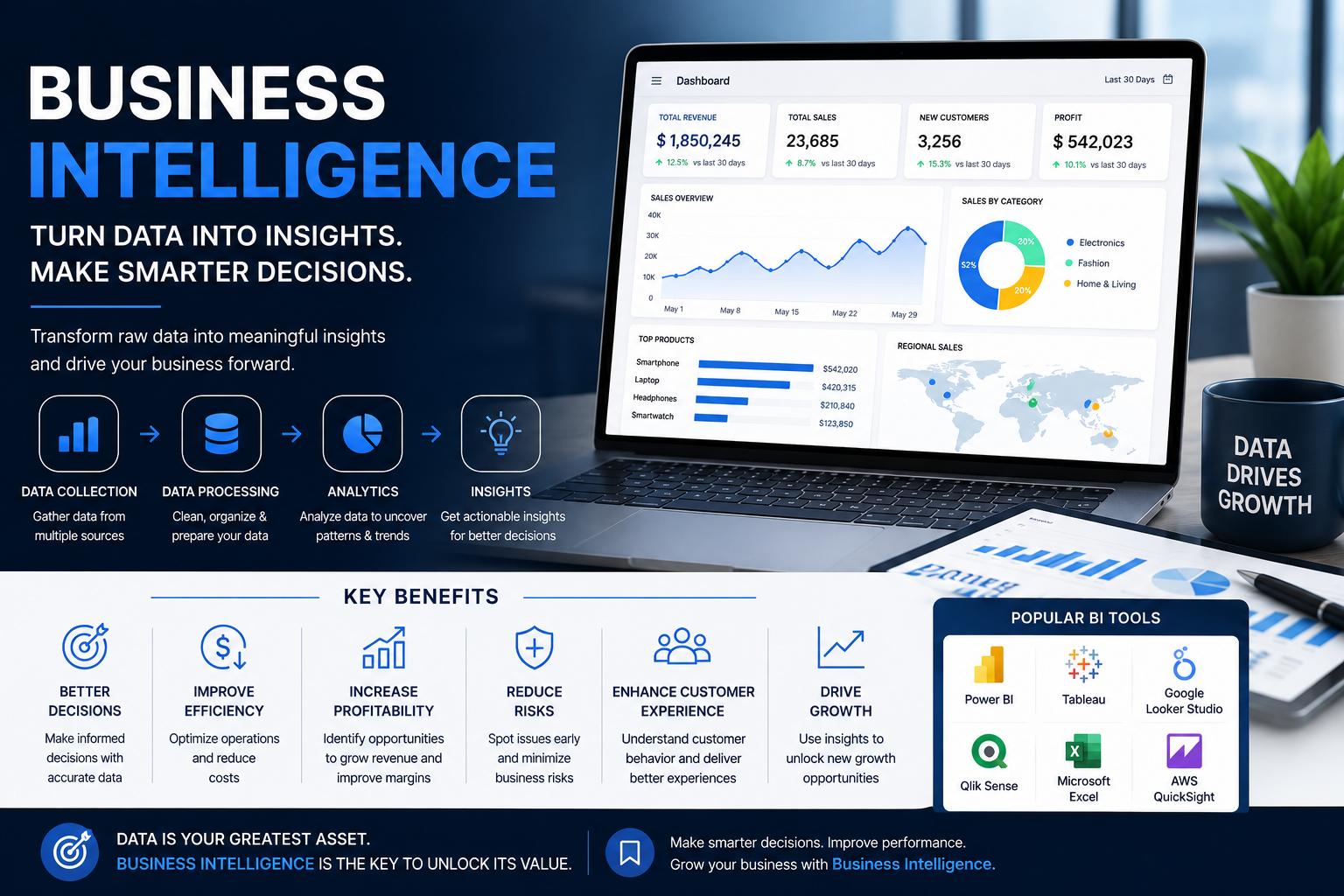
Business Intelligence (BI) enables organizations to collect, organize, visualize, and analyze data from multiple sources, turning it into actionable insights. With interactive dashboards, reports, and real-time analytics, decision-makers can identify trends, monitor performance, forecast growth, and solve problems before they become critical.
From startups to global enterprises, Business Intelligence has become an essential part of digital transformation. This guide explains what BI is, how it works, its benefits, real-world applications, and why businesses increasingly rely on data-driven strategies.
What is Business Intelligence?
Business Intelligence (BI) is the process of collecting, integrating, analyzing, and presenting business data to support informed decision-making.
Rather than relying on assumptions, BI provides accurate insights based on real-time and historical data.
Typical BI data sources include:
- CRM systems
- ERP software
- Sales platforms
- Accounting software
- Marketing campaigns
- Inventory systems
- Customer support platforms
- Websites and mobile apps
How Does Business Intelligence Work?
A Business Intelligence system generally follows these steps:
1. Data Collection
Gather information from multiple business systems.
2. Data Integration
Combine information into a centralized database or data warehouse.
3. Data Processing
Clean, organize, and prepare data for analysis.
4. Analytics
Use reports, KPIs, and visualizations to identify trends and patterns.
5. Decision-Making
Business leaders use insights to improve strategy, operations, and customer experiences.
Key Components of Business Intelligence
Data Warehousing
Centralized storage for structured business data.
Dashboards
Visual displays showing KPIs, charts, and business performance in real time.
Reporting
Generate detailed operational, financial, and management reports.
Data Visualization
Convert complex data into charts, graphs, and interactive visuals.
Predictive Analytics
Forecast future trends using AI and machine learning.
Benefits of Business Intelligence
Businesses using BI can:
- Make faster decisions
- Improve operational efficiency
- Increase profitability
- Monitor KPIs in real time
- Enhance customer experiences
- Reduce business risks
- Identify growth opportunities
- Improve forecasting
- Optimize inventory
- Support strategic planning
Industries Using Business Intelligence
BI is widely adopted across:
- Retail
- Healthcare
- Manufacturing
- Banking
- Insurance
- Education
- Logistics
- Real Estate
- Hospitality
- E-commerce
- Government
- Professional Services
Business Intelligence Use Cases
Organizations use BI to:
- Analyze sales performance
- Monitor marketing campaigns
- Forecast demand
- Optimize inventory
- Improve customer retention
- Track financial performance
- Monitor employee productivity
- Analyze operational efficiency
Business Intelligence vs Business Analytics
| Business Intelligence | Business Analytics |
|---|---|
| Focuses on current and historical performance | Focuses on predicting future outcomes |
| Uses dashboards and reports | Uses AI and statistical models |
| Supports operational decisions | Supports strategic planning |
Both complement each other and often work together.
Challenges of Business Intelligence
Businesses may encounter:
- Poor data quality
- Multiple disconnected systems
- Data security concerns
- User adoption issues
- Lack of skilled analysts
A well-designed BI strategy addresses these challenges through governance, training, and modern technology.
Best Practices
To maximize BI success:
- Define clear business objectives.
- Ensure data accuracy.
- Integrate all key business systems.
- Use interactive dashboards.
- Monitor KPIs regularly.
- Protect sensitive data.
- Continuously refine reports based on business needs.
Future Trends
Business Intelligence is evolving with:
- Artificial Intelligence (AI)
- Self-service analytics
- Real-time dashboards
- Predictive analytics
- Natural language queries
- Embedded analytics
- Cloud BI platforms
- Automated reporting
These innovations make BI faster, smarter, and more accessible to organizations of all sizes.
Frequently Asked Questions (AEO)
What is Business Intelligence?
Business Intelligence is the process of collecting and analyzing business data to generate insights that support informed decision-making.
Why is Business Intelligence important?
BI helps businesses improve efficiency, monitor performance, reduce risks, identify opportunities, and make data-driven decisions.
What is the difference between BI and analytics?
Business Intelligence primarily analyzes historical and current data, while analytics often focuses on forecasting future outcomes using statistical models and AI.
Which businesses should use Business Intelligence?
Businesses of all sizes—including retail, healthcare, finance, manufacturing, logistics, and e-commerce—can benefit from Business Intelligence.
Can small businesses use Business Intelligence?
Yes. Modern cloud-based BI tools make advanced analytics affordable and accessible for startups and small businesses.
Conclusion
Business Intelligence empowers organizations to turn raw data into meaningful insights that improve performance, strengthen decision-making, and support sustainable growth. By leveraging dashboards, reporting, analytics, and AI-powered forecasting, businesses can respond quickly to changing market conditions and uncover new opportunities.
At CodingRig, we build custom Business Intelligence solutions, interactive dashboards, and analytics platforms tailored to your business needs. Whether you're looking to monitor KPIs, analyze customer behavior, or integrate data from multiple systems, our team delivers scalable BI solutions that help you make smarter, data-driven decisions.