Cloud Migration: Complete Guide to Moving Your Business to the Cloud (2026)
Introduction
As businesses grow, their technology infrastructure must evolve to support increasing workloads, remote teams, and customer expectations. Traditional on-premises servers can become expensive to maintain, difficult to scale, and challenging to secure.
Cloud migration offers a modern solution by moving applications, databases, and business systems to cloud environments. This transition allows organizations to improve flexibility, reduce infrastructure costs, enhance security, and access resources from anywhere.
Whether you're planning to migrate a website, enterprise software, customer database, or an entire IT infrastructure, understanding the cloud migration process is essential for long-term success.
This guide explains cloud migration, its benefits, migration strategies, common challenges, and best practices for businesses in 2026.
What is Cloud Migration?
Cloud migration is the process of moving digital assets—including applications, databases, files, and workloads—from on-premises infrastructure or one cloud platform to another.
The goal is to improve performance, scalability, security, and operational efficiency while reducing hardware dependency.
Examples of cloud migration include:
- Moving a company website to cloud hosting
- Migrating databases to managed cloud services
- Deploying business software on cloud platforms
- Transferring file storage to cloud environments
- Moving virtual machines to cloud infrastructure
Why Businesses Are Moving to the Cloud
Organizations adopt cloud migration because it provides:
- Greater scalability
- Lower infrastructure costs
- Improved reliability
- Better disaster recovery
- Enhanced collaboration
- Automatic software updates
- Stronger security options
- Global accessibility
These advantages enable businesses to respond more quickly to changing market demands.
Types of Cloud Migration
Rehosting (Lift and Shift)
Applications are moved to the cloud with minimal changes, making it one of the fastest migration approaches.
Replatforming
Applications are optimized during migration to take advantage of cloud services without major architectural changes.
Refactoring
Applications are redesigned or rebuilt to fully leverage cloud-native technologies and services.
Hybrid Migration
Businesses keep some systems on-premises while moving others to the cloud, creating a hybrid environment.
Benefits of Cloud Migration
Businesses that migrate to the cloud often experience:
- Reduced IT costs
- Faster application performance
- Improved business continuity
- Enhanced security
- Easier scalability
- Better collaboration
- Remote accessibility
- Automatic backups
- Simplified infrastructure management
- Increased operational agility
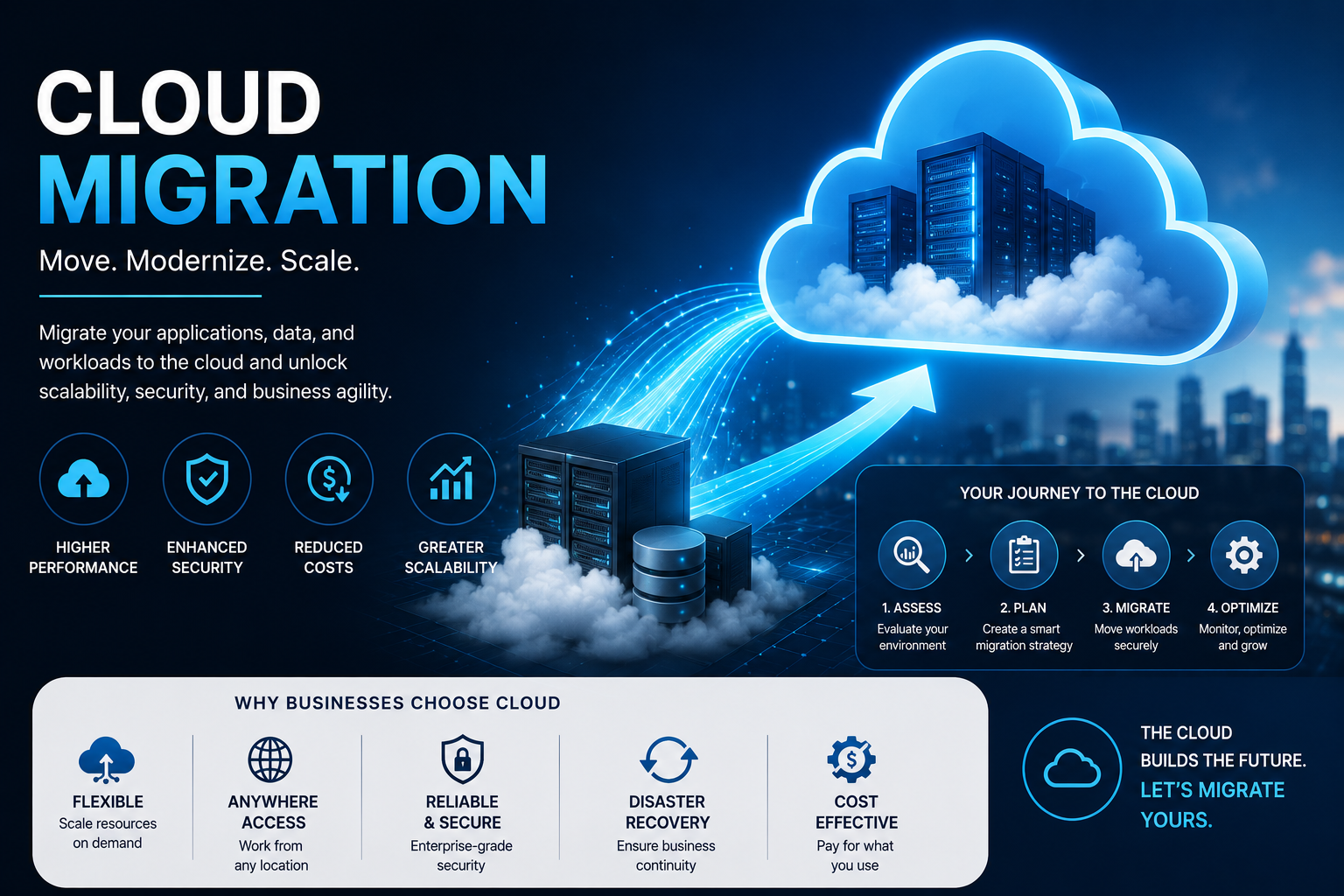
Cloud Migration Process
A successful migration typically includes:
1. Assessment
Evaluate existing infrastructure, applications, and business goals.
2. Planning
Define migration priorities, timelines, and risk management strategies.
3. Preparation
Prepare cloud environments, security settings, and backup procedures.
4. Migration
Transfer applications, databases, and workloads to the cloud.
5. Testing
Verify performance, security, and functionality after migration.
6. Optimization
Monitor cloud resources and optimize performance, security, and costs.
Common Cloud Migration Challenges
Businesses may encounter:
- Downtime during migration
- Data compatibility issues
- Security concerns
- Legacy system limitations
- Integration challenges
- Cost management
- Employee training requirements
Proper planning significantly reduces these risks.
Best Practices
To ensure a successful cloud migration:
- Assess business requirements thoroughly.
- Back up all critical data.
- Prioritize security and compliance.
- Test applications before launch.
- Monitor performance continuously.
- Train employees on new cloud systems.
- Choose scalable cloud architecture.
Industries Using Cloud Migration
Cloud migration benefits organizations across industries, including:
- Healthcare
- Finance
- Retail
- Manufacturing
- Education
- Logistics
- Government
- Hospitality
- Real Estate
- Information Technology
Future Trends
Cloud migration continues to evolve with:
- AI-powered cloud management
- Multi-cloud strategies
- Serverless computing
- Edge computing
- Cloud-native application development
- Zero Trust security
- Sustainable cloud infrastructure
Frequently Asked Questions (AEO)
What is cloud migration?
Cloud migration is the process of moving applications, data, and business workloads from on-premises systems or another cloud platform to a cloud environment.
Why is cloud migration important?
Cloud migration improves scalability, reduces infrastructure costs, strengthens security, and enables businesses to access applications from anywhere.
What are the main types of cloud migration?
The main approaches are rehosting, replatforming, refactoring, and hybrid migration.
Is cloud migration secure?
Yes. When planned and implemented correctly, cloud migration includes encryption, identity management, backups, and compliance measures to protect business data.
How long does cloud migration take?
Migration timelines depend on the size and complexity of the infrastructure. Small projects may take days or weeks, while enterprise migrations can take several months.
Conclusion
Cloud migration is more than a technology upgrade—it is a strategic investment that helps businesses become more agile, scalable, and resilient. By moving applications and data to the cloud, organizations can reduce operational costs, improve security, support remote work, and accelerate innovation.
At CodingRig, we provide end-to-end cloud migration services, helping businesses assess their infrastructure, plan migration strategies, securely transfer workloads, and optimize cloud performance. Whether you're migrating a website, enterprise application, or complete IT ecosystem, our experts ensure a smooth and reliable cloud transformation.