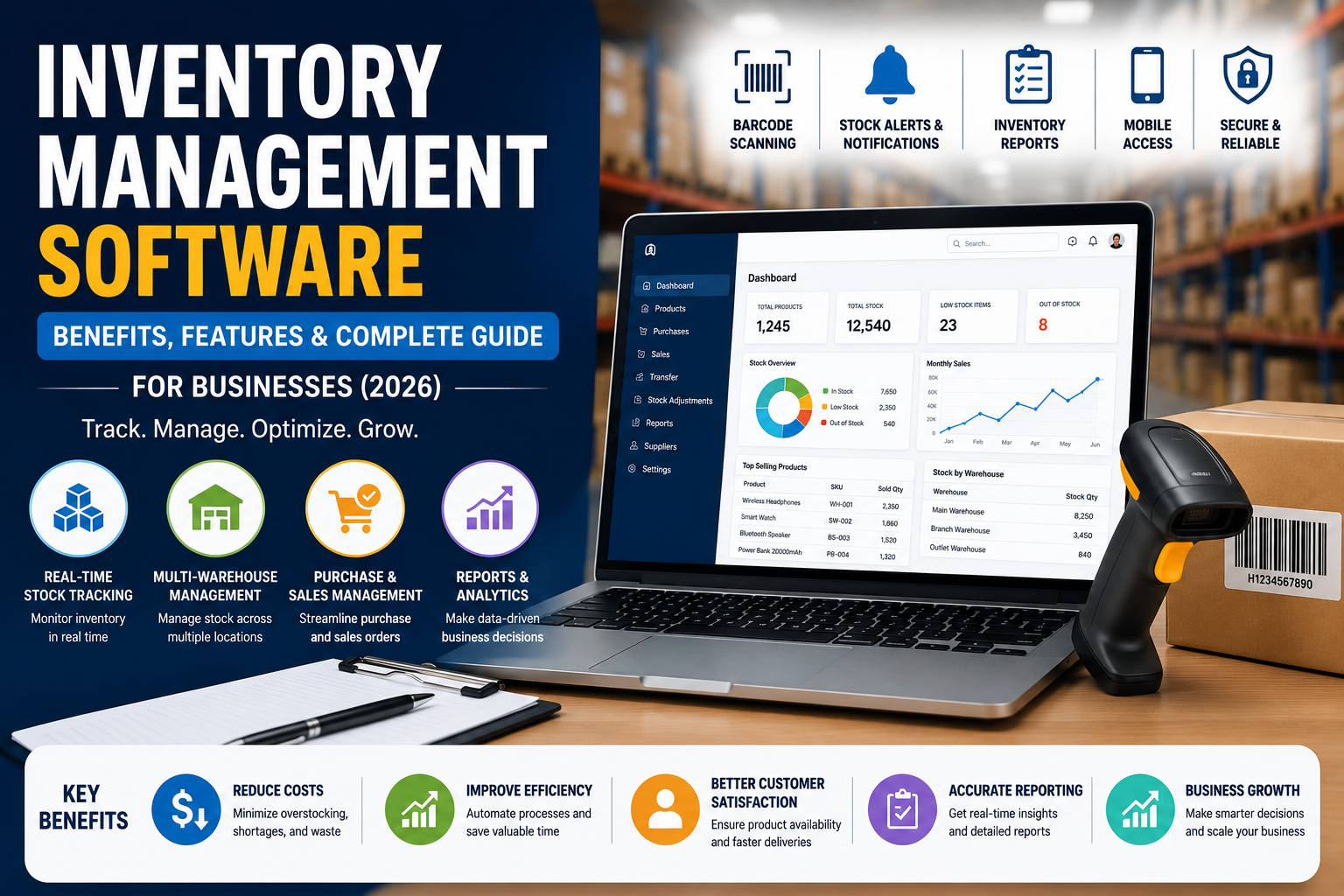
Inventory Management Software: Benefits, Features & Complete Guide for Businesses (2026)
Managing inventory efficiently is one of the biggest challenges businesses face. Whether you run a retail store, warehouse, manufacturing company, wholesale business, or e-commerce platform, keeping track of stock manually can lead to errors, delays, and unnecessary costs.
Inventory Management Software helps businesses automate inventory tracking, monitor stock levels in real time, manage purchases and sales, and optimize warehouse operations. By providing accurate inventory data, it enables organizations to reduce waste, prevent stock shortages, and improve overall business performance.
In this comprehensive guide, you'll learn what inventory management software is, how it works, its key features, benefits, and how to choose the right solution for your business.
What is Inventory Management Software?
Inventory Management Software is a digital system that helps businesses track, organize, and manage inventory throughout its lifecycle—from purchasing raw materials to selling finished products.
The software records every stock movement, including purchases, sales, transfers, returns, and adjustments, ensuring inventory data is always accurate and up to date.
Instead of relying on spreadsheets or manual records, businesses can manage inventory from a centralized dashboard accessible from anywhere.
Why is Inventory Management Software Important?
Inventory directly impacts profitability and customer satisfaction. Poor inventory management can result in:
- Stock shortages
- Overstocking
- Lost sales
- Increased storage costs
- Inventory theft
- Manual errors
- Delayed order fulfillment
Inventory Management Software automates these processes, allowing businesses to maintain optimal stock levels while reducing operational costs.
How Does Inventory Management Software Work?
Inventory software records every transaction involving stock.
A typical workflow includes:
- Products are added with unique SKUs or barcodes.
- Purchase orders increase stock quantities.
- Sales automatically reduce inventory.
- Transfers update stock across multiple warehouses.
- Returns adjust inventory levels.
- Low-stock alerts notify managers when replenishment is needed.
- Reports provide insights into stock movement, demand, and profitability.
This real-time visibility helps businesses make informed purchasing and sales decisions.
Key Features of Inventory Management Software
Real-Time Inventory Tracking
Monitor stock levels across warehouses, stores, and locations with live inventory updates.
Barcode & QR Code Scanning
Speed up inventory management using barcode or QR code scanning for receiving, issuing, and tracking products.
Multi-Warehouse Management
Manage inventory across multiple warehouses from a single platform while tracking stock transfers and availability.
Purchase Order Management
Create and manage purchase orders, track supplier deliveries, and update inventory automatically upon receiving goods.
Sales Order Management
Process customer orders efficiently while automatically updating inventory after every sale.
Stock Alerts & Notifications
Receive automatic alerts for:
- Low stock
- Overstock situations
- Expiring products
- Reorder points
This helps prevent inventory shortages and excess stock.
Batch & Serial Number Tracking
Track products using batch numbers or serial numbers, making it easier to manage warranties, recalls, and compliance requirements.
Inventory Reports & Analytics
Generate reports such as:
- Stock valuation
- Inventory turnover
- Fast-moving products
- Slow-moving products
- Purchase history
- Sales trends
- Profit margins
These insights support better business decisions.
Supplier Management
Maintain supplier information, purchase history, pricing, and delivery performance in one centralized system.
Mobile Access
Modern cloud-based inventory systems allow users to monitor inventory, approve orders, and manage stock from smartphones and tablets.
Benefits of Inventory Management Software
Improved Inventory Accuracy
Automated tracking reduces manual errors and ensures inventory records remain accurate.
Lower Operating Costs
Optimized inventory levels reduce storage costs, unnecessary purchases, and product waste.
Faster Order Fulfillment
Real-time inventory visibility enables quicker processing of customer orders.
Better Customer Satisfaction
Products remain available when customers need them, improving trust and repeat business.
Increased Productivity
Automation reduces repetitive tasks, allowing employees to focus on more valuable work.
Smarter Purchasing Decisions
Accurate inventory reports help businesses purchase the right products at the right time.
Business Growth
As your business expands, inventory software scales with additional warehouses, products, and users.
Types of Inventory Management Software
Cloud-Based Inventory Software
Hosted online and accessible from any location with an internet connection.
Best for:
- Retail businesses
- E-commerce stores
- Small businesses
- Growing companies
On-Premise Inventory Software
Installed on the company's own servers, offering complete control over data and infrastructure.
Ideal for organizations with strict security or compliance requirements.
Industry-Specific Inventory Solutions
Some inventory systems are tailored for industries such as:
- Manufacturing
- Retail
- Healthcare
- Food & Beverage
- Pharmaceuticals
- Automotive
- Construction
- Distribution
These solutions include features specific to each industry's workflows.
Industries That Benefit from Inventory Management Software
Inventory Management Software is valuable for:
- Retail stores
- E-commerce businesses
- Wholesale distributors
- Manufacturing companies
- Warehouses
- Healthcare providers
- Pharmaceutical companies
- Food and beverage businesses
- Electronics retailers
- Automotive businesses
- Construction companies
- Logistics and supply chain organizations
Common Challenges Without Inventory Software
Businesses relying on manual inventory management often experience:
- Inaccurate stock counts
- Duplicate records
- Delayed reporting
- Missed sales opportunities
- Overstocked warehouses
- Stock shortages
- Time-consuming audits
- Limited inventory visibility
An automated inventory management system helps eliminate these issues while improving operational efficiency.
How to Choose the Right Inventory Management Software
When selecting an inventory solution, consider:
- Ease of use
- Real-time inventory tracking
- Barcode support
- Multi-location management
- Cloud accessibility
- Mobile compatibility
- Integration with accounting software
- ERP integration
- CRM integration
- Custom reporting
- Data security
- Scalability
- Customer support
Choosing software that aligns with your current operations and future growth plans will maximize your return on investment.
Inventory Management Software Trends in 2026
Modern inventory systems are incorporating advanced technologies, including:
- Artificial Intelligence (AI) for demand forecasting
- Machine Learning for inventory optimization
- IoT-enabled smart inventory tracking
- RFID technology
- Automated warehouse management
- Predictive analytics
- Mobile inventory management
- Cloud-based collaboration
- Business intelligence dashboards
These innovations help businesses make proactive decisions and respond quickly to changing market conditions.
Frequently Asked Questions (AEO)
What is Inventory Management Software?
Inventory Management Software is a digital solution that helps businesses track, organize, and control inventory, ensuring accurate stock records and efficient inventory operations.
What are the benefits of inventory management software?
It improves inventory accuracy, reduces costs, prevents stock shortages, automates inventory processes, and supports better purchasing decisions.
Which businesses need inventory management software?
Retail stores, manufacturers, warehouses, wholesalers, distributors, healthcare providers, e-commerce businesses, and any company that manages physical inventory can benefit from inventory software.
Can inventory software integrate with accounting systems?
Yes. Most modern inventory systems integrate with accounting, ERP, CRM, e-commerce platforms, barcode scanners, and shipping providers.
Is cloud-based inventory software better?
Cloud-based inventory software offers flexibility, remote access, automatic updates, and scalability, making it an excellent choice for most modern businesses.
How much does inventory management software cost?
The cost varies depending on features, the number of users, deployment type, and customization requirements. Cloud solutions often use subscription pricing, while custom enterprise systems are priced based on business needs.
Conclusion
Inventory Management Software has become an essential business tool for organizations that want to improve efficiency, reduce costs, and maintain accurate stock control. By automating inventory tracking, purchase management, warehouse operations, and reporting, businesses can eliminate manual errors and make better operational decisions.
Whether you're running a small retail store or managing a large manufacturing enterprise, investing in the right inventory management solution can enhance productivity, improve customer satisfaction, and support long-term growth.
At CodingRig, we develop custom Inventory Management Software tailored to your business workflows. Our scalable, secure, and cloud-ready solutions integrate seamlessly with ERP, CRM, accounting, and e-commerce platforms, helping businesses streamline operations and achieve greater efficiency.