SaaS Development Guide: How to Build a Successful Cloud Software Product (2026)
Software as a Service (SaaS) has transformed the way businesses use software. Instead of installing applications on local computers or company servers, organizations now access powerful cloud-based software through a web browser or mobile application. This model offers greater flexibility, lower costs, automatic updates, and the ability to scale as businesses grow.
From project management tools and customer relationship management (CRM) systems to accounting platforms and HR software, SaaS solutions power businesses of every size. Whether you're a startup with an innovative idea or an established company looking to digitize your services, SaaS development can help you deliver value to customers worldwide.
This guide explains what SaaS development is, how SaaS applications work, their benefits, the development process, and best practices for building a secure and scalable cloud software product.
What is SaaS Development?
SaaS (Software as a Service) development is the process of designing, building, deploying, and maintaining cloud-based software that users access over the internet.
Unlike traditional software that requires installation on individual devices, SaaS applications run on cloud infrastructure and are typically available through a subscription model.
Users simply sign in using a web browser or mobile app to access the software from anywhere with an internet connection.
How Does SaaS Software Work?
A SaaS application is hosted on secure cloud servers managed by the software provider.
When a user logs in:
- The application authenticates the user.
- Data is securely retrieved from cloud databases.
- Business logic processes user requests.
- Results are displayed instantly.
- Data is automatically synchronized across devices.
This architecture allows businesses to provide software without requiring customers to manage servers or install updates.
Why Businesses Choose SaaS Solutions
Businesses increasingly adopt SaaS because it provides:
- Lower upfront investment
- Faster deployment
- Automatic software updates
- Access from any location
- Easy collaboration
- Better security
- High scalability
- Predictable subscription pricing
These advantages make SaaS one of the fastest-growing software delivery models.
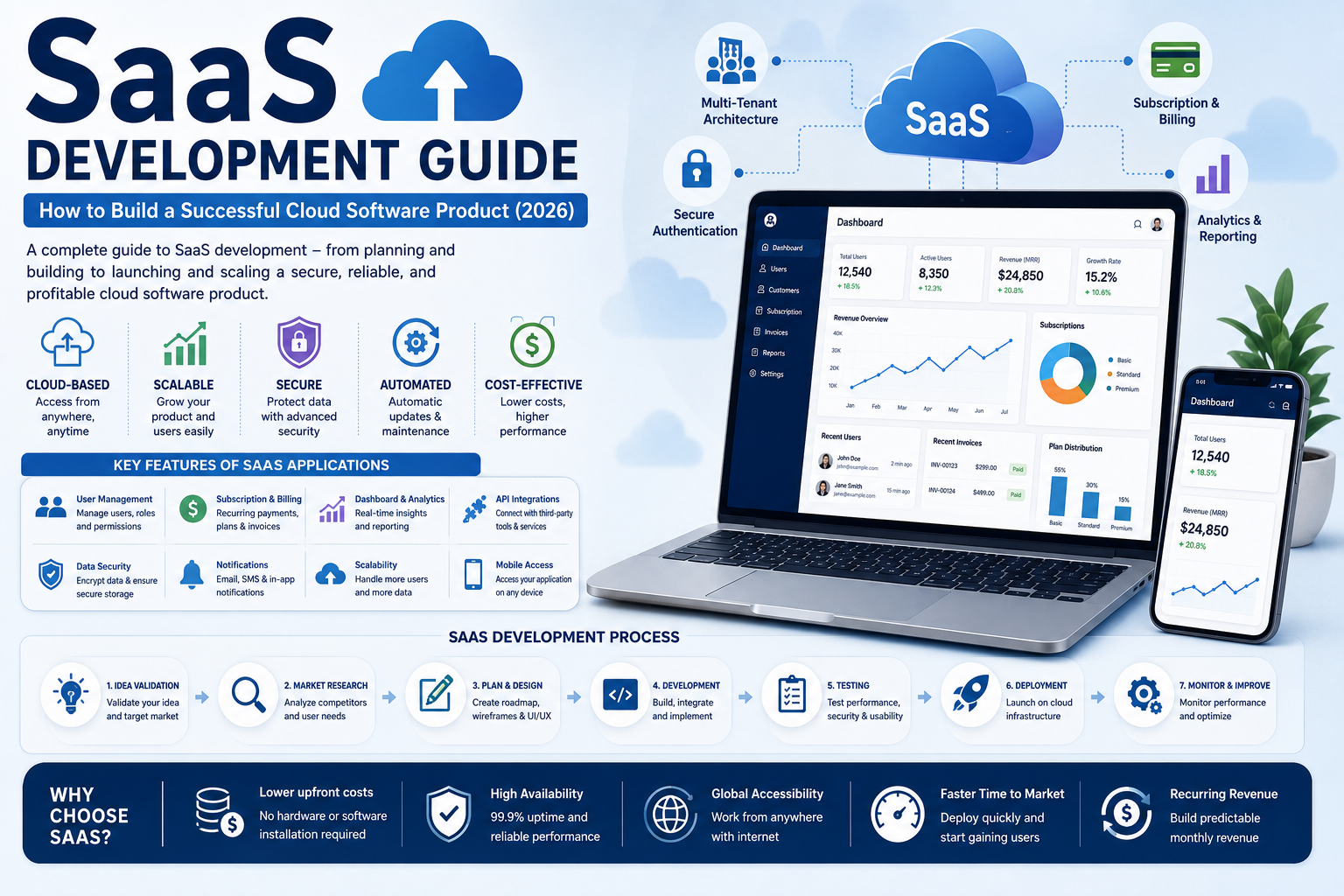
Key Features of a Successful SaaS Product
Multi-Tenant Architecture
Multiple customers share the same application while their data remains completely isolated and secure.
Secure User Authentication
Modern SaaS platforms include:
- Secure login
- Multi-factor authentication (MFA)
- Single Sign-On (SSO)
- Role-based access control
Subscription & Billing Management
Manage recurring subscriptions with features such as:
- Monthly and yearly plans
- Automated invoicing
- Payment gateway integration
- Trial periods
- Coupon management
Cloud Data Storage
Store customer information securely using encrypted cloud databases with automated backups.
Analytics Dashboard
Provide real-time insights into:
- User activity
- Revenue
- Customer growth
- Product usage
- Subscription trends
API Integration
Connect your SaaS platform with third-party services such as:
- Payment gateways
- CRM systems
- ERP software
- Email marketing tools
- Accounting platforms
- Cloud storage providers
Notifications & Communication
Keep users informed through:
- Email notifications
- Push notifications
- SMS alerts
- In-app messaging
Mobile Accessibility
Modern SaaS platforms often include responsive web applications and dedicated Android and iOS apps.
Benefits of SaaS Development
Lower Development and Maintenance Costs
Cloud infrastructure reduces hardware and maintenance expenses while simplifying software updates.
Scalability
SaaS applications can easily support growing numbers of users, data, and business operations without significant infrastructure changes.
Global Accessibility
Users can securely access the software from anywhere using desktops, tablets, or smartphones.
Automatic Updates
Customers always use the latest version without manual installations.
Better Collaboration
Teams can work together using real-time data regardless of location.
Recurring Revenue
Subscription pricing creates predictable monthly or annual revenue streams for software providers.
SaaS Development Process
1. Idea Validation
Identify a real business problem and validate market demand before starting development.
2. Market Research
Analyze competitors, customer needs, pricing models, and industry trends.
3. Define Features
Create a roadmap that includes:
- User management
- Dashboard
- Billing
- Reports
- Notifications
- Integrations
4. UI/UX Design
Design an intuitive interface that delivers a smooth user experience across devices.
5. Development
Develop the frontend, backend, APIs, database, and cloud infrastructure.
6. Testing
Conduct:
- Functional testing
- Security testing
- Performance testing
- Compatibility testing
- User acceptance testing
7. Deployment
Launch the application on a secure cloud platform with monitoring and backup systems.
8. Continuous Improvement
Gather customer feedback, release updates, fix bugs, and introduce new features regularly.
Essential Technologies for SaaS Development
A modern SaaS product may include:
Frontend
- React
- Angular
- Vue.js
Backend
- Node.js
- Laravel
- .NET
- Python
- Java
Database
- PostgreSQL
- MySQL
- MongoDB
Cloud Platforms
- AWS
- Microsoft Azure
- Google Cloud
DevOps
- Docker
- Kubernetes
- CI/CD Pipelines
The technology stack should be selected based on your product requirements, scalability goals, and development timeline.
Common Challenges in SaaS Development
Building a SaaS product involves addressing challenges such as:
- Data security
- Scalability
- Performance optimization
- User retention
- Subscription management
- Regulatory compliance
- API reliability
- Infrastructure costs
Proper planning and architecture help minimize these risks.
SaaS Development Best Practices
To build a successful SaaS application:
- Design for scalability from the beginning.
- Prioritize security with encryption and access controls.
- Keep the user interface simple and intuitive.
- Optimize application performance.
- Build a responsive design for all devices.
- Use automated testing and continuous deployment.
- Monitor system performance continuously.
- Collect user feedback to improve the product over time.
Who Should Build a SaaS Product?
SaaS development is suitable for:
- Startups
- Software companies
- Educational platforms
- Healthcare providers
- Financial services
- Logistics companies
- Manufacturing businesses
- HR service providers
- Marketing agencies
- E-commerce businesses
- Professional service firms
Future Trends in SaaS Development
The SaaS industry continues to evolve with technologies such as:
- Artificial Intelligence (AI)
- Machine Learning
- Predictive Analytics
- Low-Code Development
- No-Code Integrations
- Internet of Things (IoT)
- Voice Interfaces
- Hyper Automation
- Edge Computing
- Advanced Cybersecurity
Businesses that adopt these technologies can deliver smarter, faster, and more personalized software experiences.
Frequently Asked Questions (AEO)
What is SaaS development?
SaaS development is the process of creating cloud-based software applications that users access through the internet instead of installing them locally.
What is the difference between SaaS and traditional software?
Traditional software is installed on individual devices, while SaaS applications are hosted in the cloud and accessed online using a subscription model.
What are the benefits of SaaS development?
SaaS offers lower infrastructure costs, automatic updates, scalability, remote accessibility, recurring revenue opportunities, and simplified maintenance.
How long does it take to build a SaaS product?
The timeline depends on the complexity of the project. A basic SaaS application may take a few months, while enterprise-grade platforms with advanced features can take significantly longer.
Is SaaS suitable for small businesses?
Yes. SaaS solutions are highly scalable and allow small businesses to access enterprise-level software without investing in expensive infrastructure.
How secure are SaaS applications?
Modern SaaS applications use encryption, secure authentication, regular backups, access controls, and cloud security best practices to protect customer data.
Conclusion
SaaS development has become one of the most effective ways to deliver software in today's digital economy. With cloud-based infrastructure, subscription-based pricing, and the ability to scale globally, SaaS products offer significant advantages for both software providers and their customers.
Whether you're launching a startup or expanding an existing business, investing in a well-designed SaaS platform can help you generate recurring revenue, improve customer satisfaction, and stay competitive in an increasingly cloud-first world.
If you're planning to build a secure, scalable, and feature-rich SaaS application, CodingRig provides end-to-end SaaS development services—from product strategy and UI/UX design to cloud deployment, API integration, ongoing maintenance, and feature enhancements. Our experienced team helps transform innovative ideas into reliable cloud software products built for long-term success.