SaaS Development Guide: How to Build a Successful Cloud Software Product (2026)
Introduction
Software as a Service (SaaS) has transformed how businesses use and deliver software. Instead of installing applications on individual computers, users can access cloud-based software anytime through a web browser or mobile device. This approach provides greater flexibility, automatic updates, lower infrastructure costs, and seamless collaboration.
Today, SaaS powers everything from CRM and ERP systems to accounting software, HR platforms, project management tools, and eCommerce applications. As cloud adoption continues to grow in 2026, building a scalable and secure SaaS product has become a major opportunity for startups and enterprises alike.
This guide explains SaaS development, its benefits, architecture, essential features, and best practices for building a successful cloud-based software solution.
What Is SaaS?
Software as a Service (SaaS) is a cloud-based software delivery model where applications are hosted on remote servers and accessed over the internet. Instead of purchasing software licenses and maintaining local infrastructure, users subscribe to the service through monthly or yearly plans.
The SaaS provider manages hosting, maintenance, security, updates, and infrastructure, allowing customers to focus on using the software rather than managing it.
Popular SaaS applications include CRM systems, HRMS software, inventory management platforms, accounting solutions, collaboration tools, and Learning Management Systems (LMS).
Why SaaS Is Growing in 2026
Businesses increasingly prefer SaaS because it is cost-effective, scalable, and easy to manage.
Key advantages include:
-
Access from any device
-
Automatic software updates
-
Lower infrastructure costs
-
Subscription-based pricing
-
Faster deployment
-
Easy scalability
-
Remote collaboration
-
Improved business continuity
These benefits make SaaS an ideal solution for organizations of every size.
Steps to Build a Successful SaaS Product
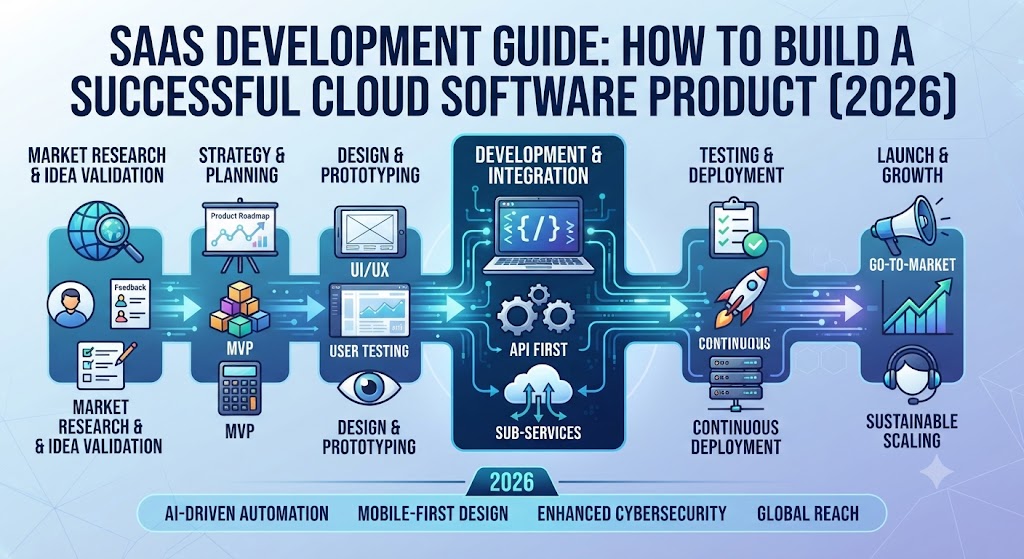
Identify a Real Problem
Every successful SaaS product solves a specific business challenge. Conduct market research, analyze competitors, and understand customer pain points before starting development.
Define Your Target Audience
Know who your software is built for by identifying:
-
Industry
-
Business size
-
User requirements
-
Budget
-
Daily challenges
-
Growth goals
A clear understanding of your audience helps shape product features and marketing strategies.
Develop a Minimum Viable Product (MVP)
Launching with an MVP allows businesses to release core features quickly, gather user feedback, and improve the product through continuous updates while reducing development costs.
Essential Features of a SaaS Application
A modern SaaS platform should include:
Secure User Authentication
Support secure login, password recovery, and multi-factor authentication to protect user accounts.
Subscription & Billing
Offer monthly and annual plans, free trials, automated invoicing, payment gateway integration, and subscription management.
User Dashboard
Provide a clean, user-friendly dashboard displaying reports, notifications, account information, and important business data.
Role-Based Access
Allow administrators, managers, employees, and customers to access only the features relevant to their responsibilities.
Reports & Analytics
Interactive dashboards and real-time reports help users monitor performance, analyze business data, and make informed decisions.
API Integration
Connect with third-party services such as ERP, CRM, payment gateways, accounting software, cloud storage, and communication platforms to automate workflows.
Cloud Infrastructure
Cloud technology is the foundation of every SaaS application. It enables businesses to scale resources automatically while maintaining high availability and security.
Cloud infrastructure provides:
-
Automatic scalability
-
High performance
-
Global accessibility
-
Reliable backups
-
Reduced hardware costs
-
Better disaster recovery
A cloud-native architecture ensures long-term flexibility and business growth.
SaaS Security Best Practices
Security is critical for protecting customer data and maintaining trust. Every SaaS application should implement:
-
HTTPS encryption
-
Secure APIs
-
Multi-factor authentication
-
Data encryption
-
Role-based permissions
-
Automated backups
-
Firewall protection
-
Continuous security monitoring
-
Compliance with privacy regulations
Strong security reduces risks while improving customer confidence.
Benefits of SaaS Development
Building a SaaS product offers significant advantages for businesses:
-
Recurring subscription revenue
-
Lower maintenance costs
-
Automatic feature updates
-
Global accessibility
-
Easy scalability
-
Better customer retention
-
Centralized data management
-
Faster deployment
-
Improved collaboration
These benefits have made SaaS one of the fastest-growing software models worldwide.
SaaS Trends in 2026
Cloud software continues to evolve with emerging technologies. Major trends include:
-
AI-powered automation
-
Predictive analytics
-
Low-code and no-code platforms
-
Embedded Business Intelligence
-
Multi-cloud deployment
-
Real-time collaboration
-
Voice-enabled interfaces
-
Personalized user experiences
-
Advanced cybersecurity
-
Cloud-native application development
Businesses adopting these innovations remain more competitive in the digital economy.
Challenges in SaaS Development
Developing SaaS software also presents challenges, including:
-
Selecting the right technology stack
-
Ensuring application scalability
-
Managing subscription billing
-
Protecting customer data
-
Performance optimization
-
API integration
-
Multi-tenant architecture
-
Ongoing maintenance and feature updates
Proper planning and experienced development teams help overcome these challenges successfully.
Why Choose Coding Rig?
At Coding Rig, we develop secure, scalable, and high-performance SaaS applications tailored to business requirements. Our services include product strategy, UI/UX design, cloud architecture, API integration, payment gateway integration, subscription management, mobile compatibility, security implementation, and ongoing maintenance.
We build SaaS solutions for industries including healthcare, finance, education, logistics, retail, manufacturing, real estate, HR, and enterprise management. Every application is designed for performance, scalability, and exceptional user experience, helping businesses launch successful cloud-based products with confidence.
Conclusion
SaaS development has become the preferred approach for delivering modern software in 2026. Cloud-based applications offer flexibility, lower costs, automatic updates, and seamless accessibility, making them ideal for businesses of every size.
Building a successful SaaS product requires understanding customer needs, designing scalable architecture, implementing strong security, and continuously improving the platform. By investing in the right SaaS strategy and partnering with experienced developers, businesses can create innovative cloud software that supports long-term growth and delivers lasting value to customers.